
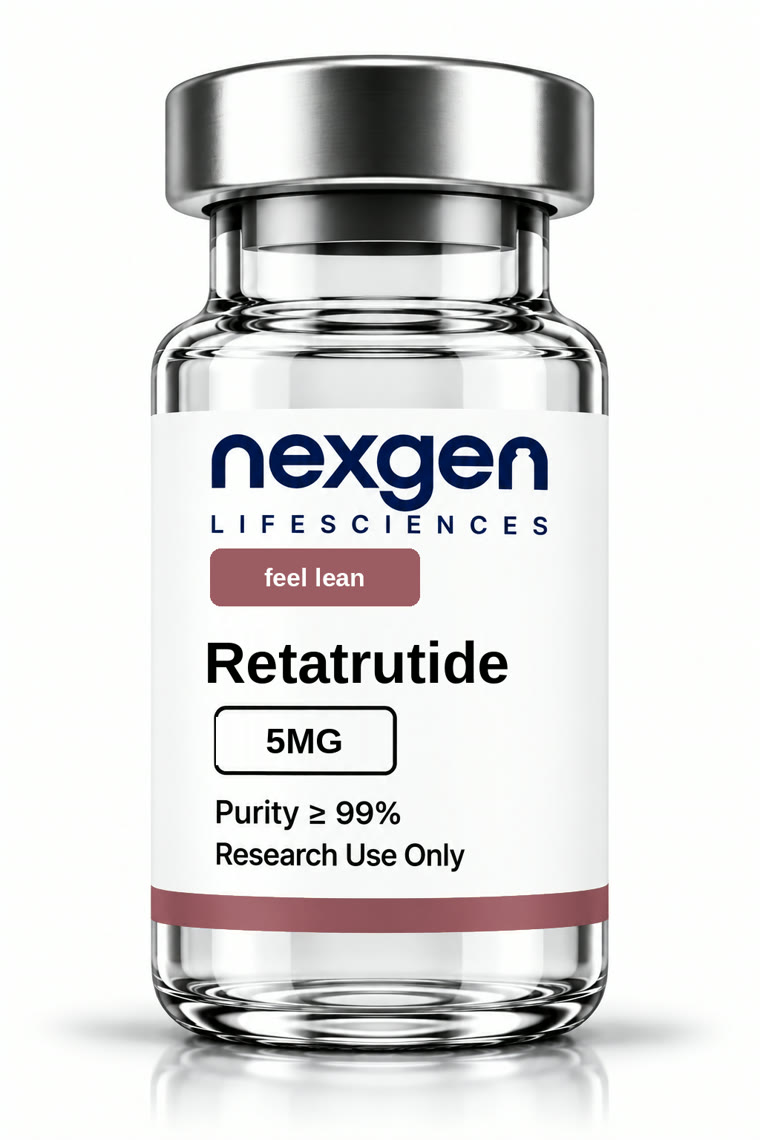
Retatrutide
Three receptors instead of two. It cuts intake and raises energy burn, and it has the largest weight-loss numbers in its class.
- Evidence
- BHuman trials what's this?
Grade B. Strong Phase 2 trials and a reported Phase 3, but not yet approved anywhere. - Also known as
- LY3437943 · sometimes nicknamed "GLP-3" (not a real hormone)
- Class
- Triple GIP + GLP-1 + glucagon receptor agonist. Investigational, Eli Lilly.
What it is
Semaglutide activates one gut-hormone receptor and tirzepatide activates two. Retatrutide, from Eli Lilly, adds a third: glucagon. It's a single peptide with a fatty-acid tail that gives it a half-life of about six days, so like the others it's injected once a week.
The results are why it matters. Phase 2 produced the largest average weight loss reported for any incretin drug at the time, and the Phase 3 TRIUMPH topline in December 2025 reported about 28.7% average body-weight loss over 68 weeks3. It is not approved yet. Legitimate access is through clinical trials only.
How it works
The glucagon arm explains both of retatrutide's standout features: the dramatic drop in liver fat, and a heart-rate rise that is larger than with the other incretin drugs.
What the research shows
Phase 2 obesity trial (Jastreboff, NEJM 2023): weight loss rose with dose, reaching 24.2% at 48 weeks on 12 mg, with better blood pressure, lipids and glucose. 72% of participants with prediabetes went back to normal glucose levels1.
Liver-fat substudy (Nature Medicine 2024): liver fat fell by up to 82% at 24 weeks, and more than 90% of the top-dose group reached normal liver-fat levels2.
Phase 3 (TRIUMPH): the topline reported about 28.7% average loss at 68 weeks. Full peer-reviewed publication is still pending3.
Evidence at a glance
| Use | Grade | Best evidence | Main gap | Read |
|---|---|---|---|---|
| Weight loss | BHuman trials | 24.2% (Ph 2) and ~28.7% (Ph 3 topline)1,3 | Not yet approved | Largest in class |
| Liver fat | BHuman trials | Up to 82% reduction2 | Phase 2a size | Striking |
| Glucose, prediabetes | BHuman trials | 72% reverted to normal glucose1 | Not approved | Strong |
Dosing: what has been reported
| Setting | Figure | Route | Grade |
|---|---|---|---|
| Trial protocol | Start 2 mg, step up about every 4 weeks; arms of 4, 8 and 12 mg; strongest effect at 8–12 mg1 | Subcutaneous, weekly | B |
| Clinical | No approved protocol, because the drug is investigational | — | — |
| Community | Copies the trial titration, starting at 1–2 mg | Subcutaneous, weekly | D |
| Trial step | Weekly dose | What to watch |
|---|---|---|
| 1 | 2 mg | The first and biggest nausea wave. A tolerance step, not a weight-loss dose. |
| 2 | 4 mg | A new GI wave; start checking heart rate |
| 3 | 8 mg | Strong appetite suppression. Make sure protein intake keeps up. |
| 4 | 12 mg | Highest studied dose. Many people do well below it. |
Heart rate is the extra checkpoint with retatrutide. Check it before every step up, and hold or step back if it climbs or you feel palpitations. Slower half-steps (2 → 4 → 6 → 8 mg) are used when the standard steps are rough.
Preparing & storing
Trial supply is a refrigerated, ready-made injectable. Lyophilised research material is reconstituted with bacteriostatic water, swirled gently, kept at 2–8 °C and away from light. Inject on the same weekday each week into the abdomen, thigh or upper arm, rotating sites.
Reported side effects
- Nausea (about 43% in trials), diarrhoea (about 33%), vomiting, constipation, all worst during step-ups
- Heart-rate increase, dose-dependent, from the glucagon arm
- Injection-site reactions; some skin-sensitivity reports
- Class effects: gallbladder problems, a pancreatitis signal, muscle loss during rapid weight loss
Who should avoid it
- Personal or family history of medullary thyroid cancer or MEN2
- History of pancreatitis or serious GI disease
- Pregnancy and breastfeeding
- Significant heart disease (discuss the heart-rate effect with a doctor)
- Do not combine with semaglutide, tirzepatide or other incretin drugs
- Insulin and sulfonylurea doses need medical review
Regulatory status checked Oct 2026
| Body | Status | Detail |
|---|---|---|
| FDA (US) | Not approved | Phase 3 reported; submission expected. Available through trials only. |
| EMA (EU) | Not approved | Investigational. |
| CDSCO (India) | Not approved | Investigational. |
| WADA | Not named | Not on the prohibited list. Athletes should check the current status. |
The most powerful compound in this guide, still in development
Retatrutide works on intake and expenditure at once, and the trial numbers reflect that. It still needs slow titration, heart-rate checks and plenty of protein. Its long-term safety record is still being built. With an investigational drug, independent testing of every batch matters even more.
References
- Jastreboff AM, Kaplan LM, Frías JP, et al. Triple-hormone-receptor agonist retatrutide for obesity: a phase 2 trial. N Engl J Med. 2023;389(6):514–526. doi:10.1056/NEJMoa2301972
- Sanyal AJ, Kaplan LM, Frías JP, et al. Triple hormone receptor agonist retatrutide for MASLD: a randomized phase 2a trial. Nat Med. 2024. doi:10.1038/s41591-024-03018-2
- Eli Lilly. TRIUMPH Phase 3 topline results, December 2025: about 28.7% mean weight reduction at 68 weeks. Full publication pending.