
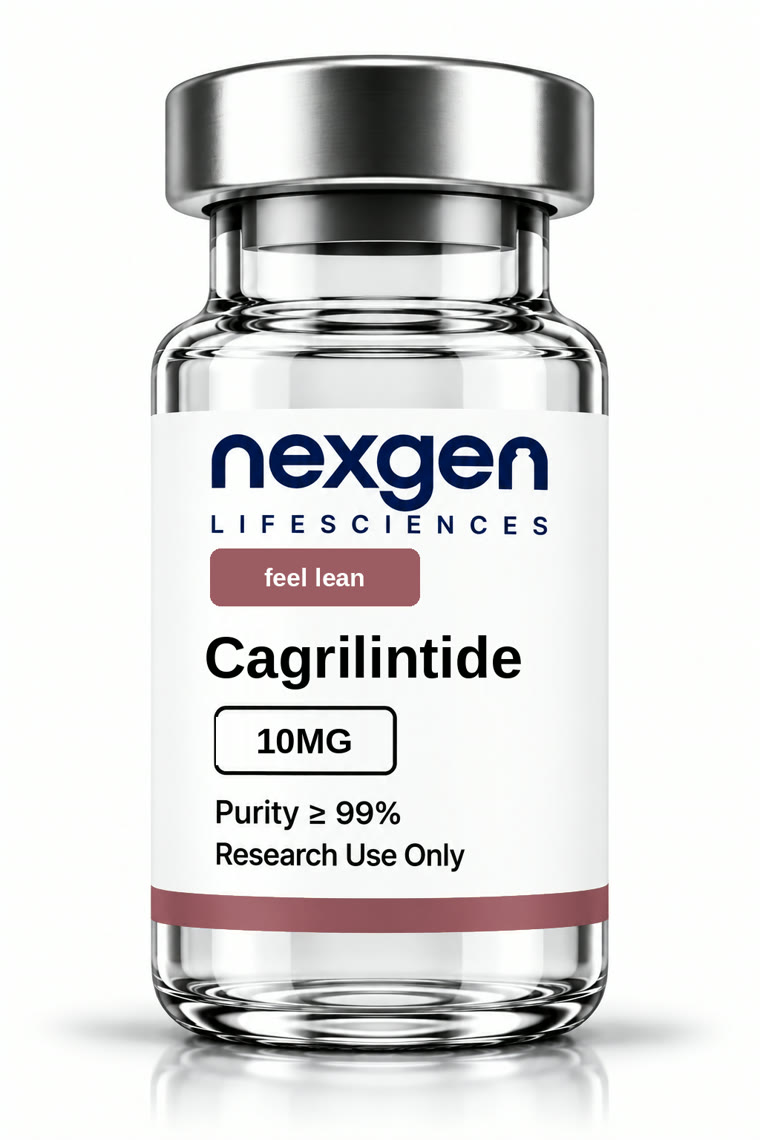
Cagrilintide
A once-weekly version of amylin, the body’s own fullness hormone. It works on a different appetite brake from GLP-1.
- Evidence
- BHuman trials what's this?
Grade B. Well-run Phase 2 trials alone, plus Phase 3 as part of CagriSema. - Also known as
- AM833 · NNC0174-0833
- Class
- Acylated long-acting amylin analogue. Investigational, Novo Nordisk.
What it is
Every time you eat, your pancreas releases amylin alongside insulin. Amylin tells the brain you’ve had enough, slows the stomach and quiets the urge to keep eating. The older amylin drug, pramlintide, works but has to be injected before every meal. Cagrilintide carries a fatty-acid chain that stretches its half-life to roughly 160–180 hours, so one injection covers the whole week.
How it works
Because amylin and GLP-1 are different brakes, adding one to the other gives a bigger combined effect rather than doubling up on the same mechanism. That reasoning is behind CagriSema.
What the research shows
Phase 2 dose-finding (Lau, Lancet 2021): 706 adults received weekly doses from 0.3 to 4.5 mg against placebo and liraglutide for 26 weeks. Weight loss rose with dose, reaching about 10.8% at 4.5 mg1. Phase 1b with semaglutide: about 17% in 20 weeks, and neither drug changed how the body handled the other2. Later trials of the combination in diabetes3 and in obesity4 pushed results into the 20% range (see CagriSema).
Evidence at a glance
| Use | Grade | Best evidence | Main gap | Read |
|---|---|---|---|---|
| Weight loss, alone | BHuman trials | ~10.8% at 4.5 mg, 26 weeks1 | Not approved | Real effect |
| With semaglutide | BHuman trials | ~17% in 20 weeks; no interaction2 | Combination still in review | Additive |
| Satiety mechanism | BHuman trials | Slower emptying, more fullness | — | Well established |
Dosing: what has been reported
| Setting | Figure | Route | Grade |
|---|---|---|---|
| Published trials | 0.3, 0.6, 1.2, 2.4 or 4.5 mg weekly, increased gradually1 | Subcutaneous | B |
| In CagriSema | 2.4 mg fixed, with semaglutide 2.4 mg | Subcutaneous | B |
| Community | Follows the trial steps: 0.3 → 0.6 → 1.2 → 2.4 (→ 4.5) mg, about every 4 weeks | Subcutaneous | D |
Nausea is usually milder than with the GLP-1 drugs, and there’s no meaningful heart-rate effect. Hold a step if side effects haven’t settled. When it’s used as part of CagriSema, follow the combined titration instead of running two separate climbs.
Preparing & storing
Reconstitute with bacteriostatic water, swirl gently, refrigerate and protect from light. One mixed vial covers several weekly doses. Inject on the same day each week and rotate sites. Meal timing doesn’t matter.
Reported side effects
- Nausea (most common, worst during increases), sometimes vomiting
- Reduced appetite that can tip into eating too little
- Constipation or diarrhoea
- Mild injection-site reactions; occasional early fatigue
Trials found it well tolerated, with mostly mild to moderate effects. Like all stomach-slowing drugs, it can delay absorption of oral medicines.
Who should avoid it
- Pregnancy and breastfeeding
- Eating disorders: appetite suppressants are not appropriate
- History of pancreatitis or serious GI disease (needs medical input)
- People taking glucose-lowering drugs need monitoring
- Tested athletes: unapproved substances fall under WADA S0
Regulatory status checked Oct 2026
| Body | Status | Detail |
|---|---|---|
| FDA (US) | Not approved | Investigational; development is mainly as CagriSema. |
| EMA (EU) | Not approved | Investigational. |
| CDSCO (India) | Not approved | No approval identified. |
| WADA | S0 risk | Amylin itself isn’t banned, but non-approved substances fall under S0. |
A real second appetite brake
Unlike most research peptides, cagrilintide has proper human trials behind it. On its own it gives moderate weight loss with a gentler side-effect profile than GLP-1s. It is most valuable as a partner to semaglutide.
References
- Lau DCW, Erichsen L, Francisco AM, et al. Once-weekly cagrilintide for weight management: a dose-finding phase 2 trial. Lancet. 2021;398(10317):2160–2172. PMID 34798060
- Enebo LB, Berthelsen KK, Kankam M, et al. Cagrilintide with semaglutide 2.4 mg for weight management: a phase 1b trial. Lancet. 2021;397(10286):1736–1748. PMID 33894838
- Frías JP, Deenadayalan S, Erichsen L, et al. Co-administered cagrilintide and semaglutide in type 2 diabetes: a phase 2 trial. Lancet. 2023;402(10403):720–730.
- Garvey WT, Blüher M, Osorto Contreras CK, et al. Coadministered cagrilintide and semaglutide in adults with overweight or obesity. N Engl J Med. 2025;393(7):635–647.