
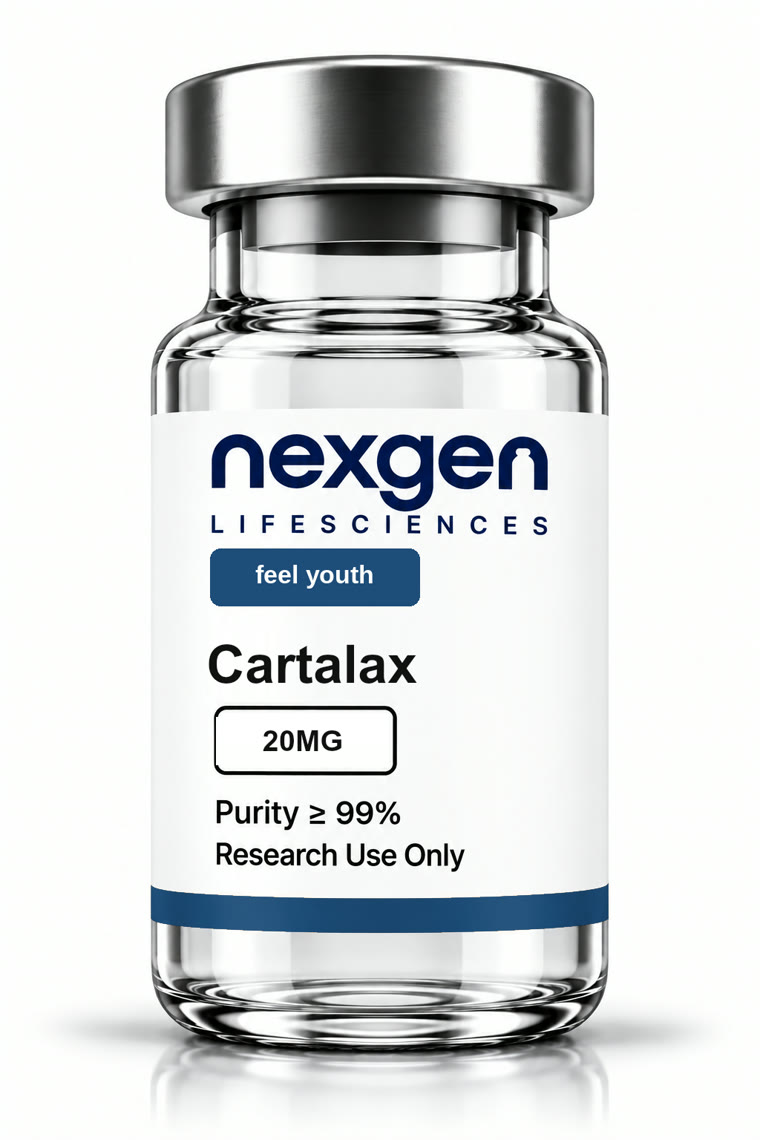
Cartalax
A tiny peptide said to remind ageing cartilage cells how to repair themselves. The evidence stops at the lab dish.
- Evidence
- ELab & animal what's this?
Grade E. Cell culture only, from essentially one research lineage. - Also known as
- AED peptide · Kartalax
- Class
- Short synthetic Khavinson bioregulator, cartilage-directed. Exact sequence disputed.
What it is
Cartalax is one of the St Petersburg "bioregulators", a family of very short peptides each aimed at one tissue. Its relatives here are Epitalon and Pinealon. Its identity is disputed. Some sources define it as the tripeptide AED, others sell a four-residue version, and a few confuse it with Epitalon’s sequence. A buyer often can’t be sure which molecule is in the vial.
How it’s proposed to work
What the research shows
In the lab: in ageing human stem-cell cultures, AED raised IGF1 gene expression about 3.5–5.6-fold and shifted other ageing-related genes1. A 2023 review grouped AED with short peptides studied for steering stem cells toward cartilage2. In animals and people: no solid independent animal work, and no human trial.
Evidence at a glance
| Use | Grade | Best evidence | Main gap | Read |
|---|---|---|---|---|
| Cartilage and joints | ELab & animal | Studied for cartilage-cell regulation2 | Cell culture, one lineage | Unproven |
| Gene expression | ELab & animal | IGF1 up 3.5–5.6× in ageing stem cells1 | A dish, not a joint | Preliminary |
| Reaches cartilage | ELab & animal | Theoretical | Delivery unresolved | Speculative |
Dosing: what has been reported
| Setting | Figure | Route | Grade |
|---|---|---|---|
| Published human | None | — | — |
| Community | ~1–2 mg/day in short pulsed courses, repeated periodically | Subcutaneous (or oral courses) | D |
Preparing & storing
Dissolves in bacteriostatic water. Keep the powder cool and dark, refrigerate once mixed and handle gently.
Reported side effects
- Mild injection-site redness
- Most reports describe no noticeable effect, good or bad
The real risks are the unknowns: human safety, and whether the vial holds the molecule that was studied.
Who should avoid it
- Active or past cancer: it raised IGF1 expression, a growth signal
- Pregnancy and breastfeeding
- Anyone wanting evidence-backed joint support
Regulatory status checked Oct 2026
| Body | Status | Detail |
|---|---|---|
| FDA (US) | Not approved | Research use only. |
| EMA (EU) | Not approved | — |
| CDSCO (India) | Not approved | — |
| WADA | Not named | S0 could apply. |
The thinnest evidence in the Youth section
Cartalax rests on cell-culture work from one research lineage, an unproven mechanism and a delivery problem. Set expectations very low, and make sure any supply is identity-tested.
References
- Ashapkin V, Khavinson V, Shilovsky G, et al. Gene expression in human mesenchymal stem cell aging cultures: modulation by short peptides. Mol Biol Rep. 2020;47(6):4323–4329.
- Linkova N, Khavinson V, Diatlova A, et al. Peptide regulation of chondrogenic stem cell differentiation. Int J Mol Sci. 2023;24(9):8415.
- Khavinson VK, Popovich IG, Linkova NS, et al. Peptide regulation of gene expression: a systematic review. Molecules. 2021;26(22):7053.