
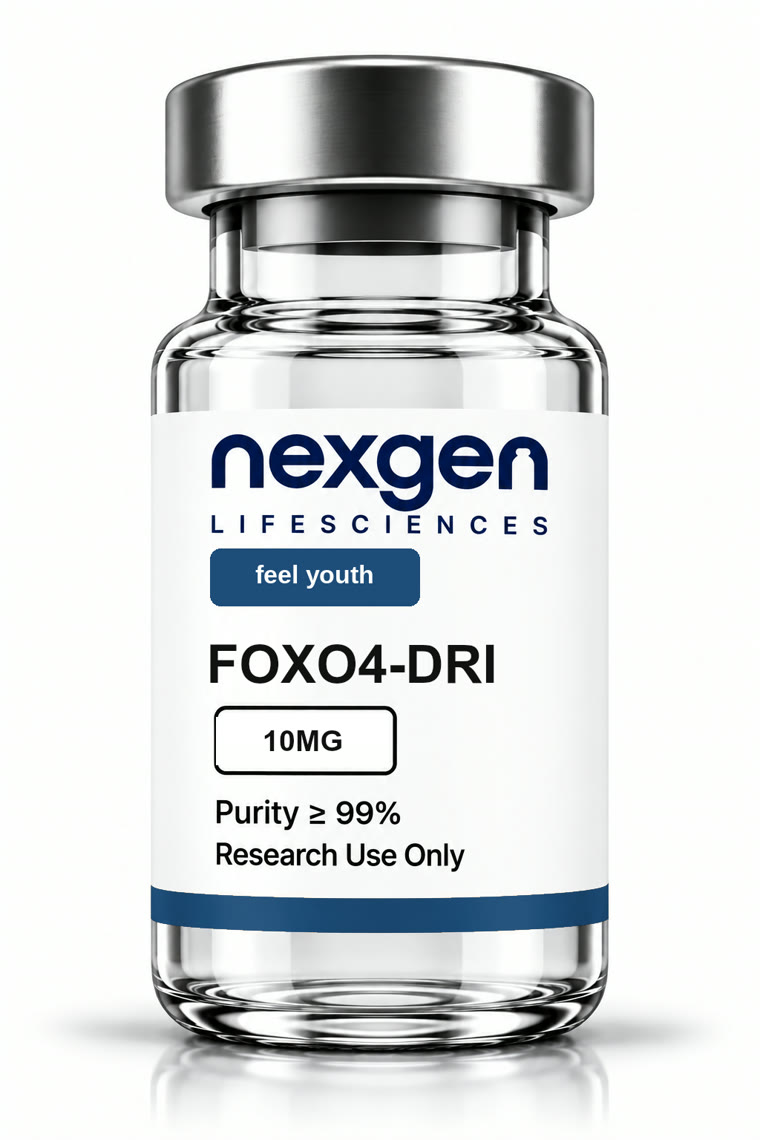
FOXO4-DRI
Designed to make "zombie" cells finally die and leave healthy cells alone. Remarkable in mice, and never tested in a human.
- Evidence
- ELab & animal what's this?
Grade E. The mechanism is replicated in cells and mice. There is no human data of any kind. - Also known as
- FOXO4 D-Retro-Inverso peptide
- Class
- Synthetic D-retro-inverso senolytic peptide. Frontier research compound.
What it is
With age, some damaged cells stop dividing but refuse to die. These senescent cells pile up and leak inflammatory signals (the SASP) that damage surrounding tissue. Clearing them reverses aspects of ageing in animals. FOXO4-DRI was built in 2017 to do exactly that. "D-retro-inverso" means it’s made from mirror-image amino acids in reverse order, so it resists breakdown but keeps its shape.
How it works
The effect is temporary. Senescent cells build up again over roughly 8–12 weeks, which is why the research describes periodic clearance rather than continuous use.
What the research shows
In mice (Baar et al., Cell 2017): in naturally aged mice it improved physical activity, kidney function and fur density together, reduced senescence markers, helped recovery from chemotherapy toxicity, and counteracted ageing in a fast-ageing strain. The dose was 5 mg/kg into the abdomen three times a week1. Independent replication: it selectively cleared senescent human cartilage cells2, and in separate work it cleared senescent vessel cells and improved vascular ageing in mice through p533. In people: nothing.
Evidence at a glance
| Use | Grade | Best evidence | Main gap | Read |
|---|---|---|---|---|
| Clears senescent cells | ELab & animal | Selective, replicated1,2 | Cells and mice | Real mechanism |
| Reverses signs of ageing | ELab & animal | Activity, kidney, fur improved1 | Mouse only | Striking |
| Vascular ageing | ELab & animal | Improved aortic ageing3 | Preclinical | Supportive |
| Human safety and benefit | ELab & animal | None | Never tested | Unknown |
Dosing: what has been reported
| Setting | Figure | Route | Grade |
|---|---|---|---|
| Published human | None. Mouse protocol: 5 mg/kg intraperitoneal ×3 weekly1 | — | — |
| Community pulse | ~1 mg/day, 5 days on and 2 off, 2-week course, 2–3 times a year | Subcutaneous | D |
| Community, higher | 2–10 mg (some to 25 mg) every other day, ~3 doses per cycle | Subcutaneous | D |
| Community, weekly | 5–10 mg weekly or fortnightly over a 4–8-week cycle | Subcutaneous | D |
The range, from under 1 mg to 25 mg per dose, shows that nobody knows the human dose. Cycles are spaced 3–6 months apart. The community rule is "clear first, rebuild after": regenerative peptides come after a cycle, not during it.
Preparing & storing
A common mix is 10 mg in 2 mL of bacteriostatic water (5 mg/mL; 1 mg = 20 units on a U-100 syringe). Store the powder frozen, refrigerate once mixed and use within about two weeks. Injection-site soreness is notably more common and longer-lasting than with most peptides, so inject slowly at room temperature and rotate sites widely.
Reported side effects
- Injection-site soreness lasting several days, worse at higher doses
- Mild fatigue, muscle soreness, nausea (anecdotal)
- Real human side-effect profile: unknown
People who use it track a general health panel plus p16INK4a and SASP markers (IL-6, TNF-α, hs-CRP) before and after a cycle.
Who should avoid it
- Active or past cancer. p53 and apoptosis are central to cancer biology.
- Pregnancy and breastfeeding: avoid absolutely
- Anyone on chemotherapy or other apoptosis-affecting drugs
- Realistically, anyone unwilling to be an early human test
Regulatory status checked Oct 2026
| Body | Status | Detail |
|---|---|---|
| FDA (US) | Not approved | Research compound. |
| EMA (EU) | Not approved | — |
| CDSCO (India) | Not approved | — |
| WADA | Not named | S0 could apply. |
Frontier science, frontier risk
FOXO4-DRI has one of the most elegant mechanisms in this guide and replicated mouse data. It also has no human dose, no human safety data, and it works by making cells die. If you are not a researcher, the right place for it is in your reading, not in a syringe.
References
- Baar MP, Brandt RMC, Putavet DA, et al. Targeted apoptosis of senescent cells restores tissue homeostasis in response to chemotoxicity and aging. Cell. 2017;169(1):132–147. PMID 28340339
- Senolytic peptide FOXO4-DRI selectively removes senescent cells from in vitro expanded human chondrocytes. 2021. PMC8116695
- FOXO4-DRI regulates endothelial cell senescence via the p53 signaling pathway. PMC12852416