
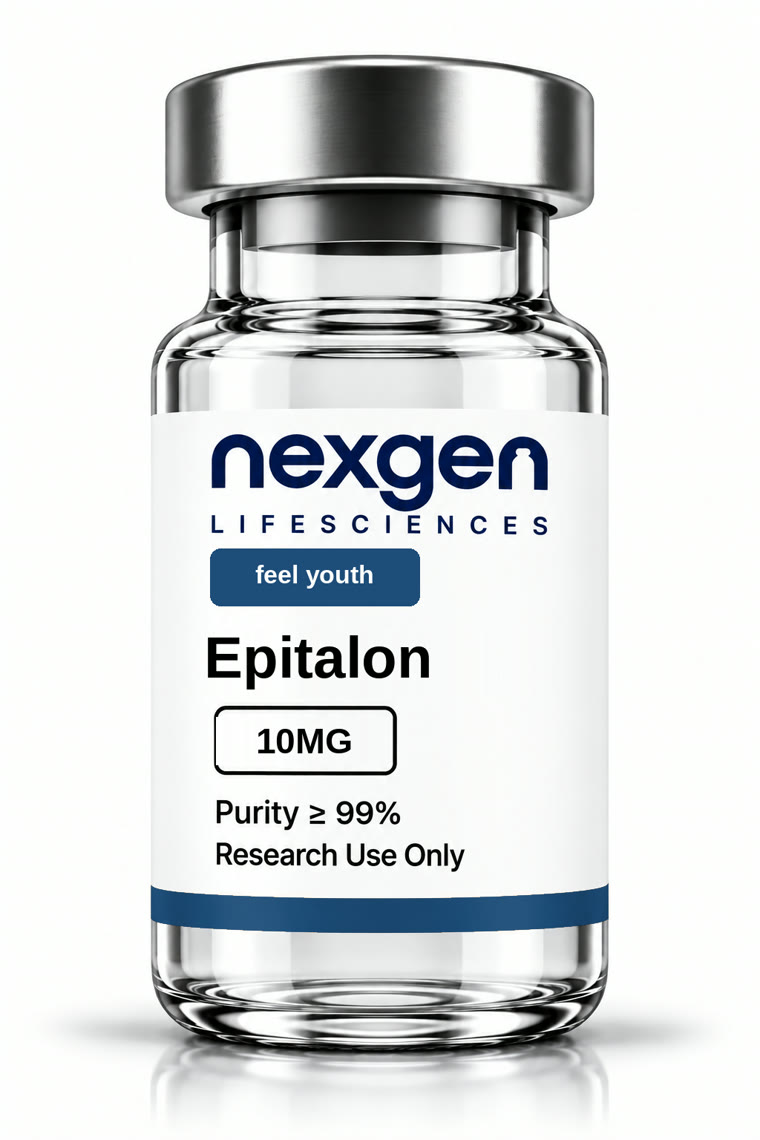
Epitalon
Four amino acids aimed at the cell’s ageing clock and the body clock, the flagship of the bioregulator family.
- Evidence
- DCommunity use what's this?
Grade D for use. Grade E cell data, now independently replicated; human data are weak. - Also known as
- Epithalon · Epithalone · AEDG peptide
- Class
- Synthetic pineal tetrapeptide (Ala-Glu-Asp-Gly); Khavinson bioregulator
What it is
The pineal gland makes melatonin and helps run your body clock, and its output fades with age. Epitalon was developed in St Petersburg as a four-amino-acid version of a pineal extract. It targets two things: the pineal gland, and telomeres, the protective caps on chromosomes that shorten with every cell division. It is registered as a bioregulator in its country of origin and is a research compound everywhere else.
How it works
What the research shows
In the lab: in human cells Epitalon raised telomerase and extended cell division1. Importantly, an independent Western lab replicated telomere lengthening in human cell lines in 20252. In animals: it extended mouse lifespan and reduced spontaneous tumours3. Animal work also showed restored melatonin rhythms. In people: a 266-person elderly programme reported lower mortality, especially combined with thymalin, and a long follow-up reported roughly 25% lower overall and about 50% lower cardiovascular mortality4,5. Those studies were non-blinded, came from a single group, and mostly used the extract rather than the synthetic peptide.
Evidence at a glance
| Use | Grade | Best evidence | Main gap | Read |
|---|---|---|---|---|
| Telomerase and telomeres | ELab & animal | Lengthened telomeres, independently replicated1,2 | Cell level; dose gap | Real |
| Lifespan and tumours | ELab & animal | Longer life, fewer tumours in mice3 | Animal only | Supportive |
| Human mortality | BHuman trials | Lower mortality in elderly cohorts4,5 | Non-blinded, extract | Suggestive |
| Melatonin and sleep | DCommunity use | Partial rhythm restoration | Limited | Plausible |
Dosing: what has been reported
| Setting | Figure | Route | Grade |
|---|---|---|---|
| Published human | Mostly the extract on course schedules; no validated synthetic dose | — | — |
| Community | ~5–10 mg/day for 10–20-day courses, 1–4 times a year | Subcutaneous | D |
The bioregulator approach uses short pulsed courses rather than continuous use. Some people dose at night because of the melatonin link, though Epitalon isn’t a sedative.
Preparing & storing
Reconstitute with bacteriostatic water, refrigerate and handle gently. Rotate injection sites across a course.
Reported side effects
- Mild injection-site redness or a lump
- Occasional drowsiness, in line with the melatonin effect
- Uncommon mild headache
The long Russian studies reported good tolerance. The effect you might notice is on sleep. Any effect on lifespan can’t be felt or measured in the short term.
Who should avoid it
- Active or past cancer. Telomerase is what cancer cells use to divide endlessly. Mice showed fewer tumours, not more, but this isn’t resolved in humans.
- Pregnancy and breastfeeding
- Anyone with a serious condition or on regular medication: get medical input
Regulatory status checked Oct 2026
| Body | Status | Detail |
|---|---|---|
| FDA (US) | Not approved | Under compounding review; research use only. |
| EMA (EU) | Not approved | No marketing authorisation. |
| CDSCO (India) | Not approved | Registered as a bioregulator in its country of origin. |
| WADA | Not named | S0 could apply to an unapproved injectable. |
The most credible bioregulator
Epitalon’s telomere effect has now been replicated outside its home lab, and its human data were gathered in older adults, which is the right population. Those human studies are still weak, there’s no validated dose, and the cancer question is open.
References
- Khavinson VKh, Bondarev IE, Butyugov AA. Epithalon peptide induces telomerase activity and telomere elongation in human somatic cells. Bull Exp Biol Med. 2003;135(6):590–592. PMID 12937682
- Al-Dulaimi S, Thomas R, Matta S, Roberts T. Epitalon increases telomere length in human cell lines through telomerase upregulation or ALT activity. 2025. PMID 40908429
- Anisimov VN, Khavinson VKh, Provinciali M, et al. Effect of Epitalon on biomarkers of aging, life span and spontaneous tumor incidence in female SHR mice. Biogerontology. 2003;4(4):193–202.
- Korkushko OV, Khavinson VKh, Shatilo VB, Antonyuk-Shcheglova IA. Peptide geroprotector from the pineal gland inhibits ageing of the cardiovascular system. Bull Exp Biol Med. 2006. (Extract, non-blinded)
- Khavinson VKh, Morozov VG. Peptides of pineal gland and thymus prolong human life. Neuroendocrinol Lett. 2003;24(3–4):233–240. (Extract, non-blinded)