
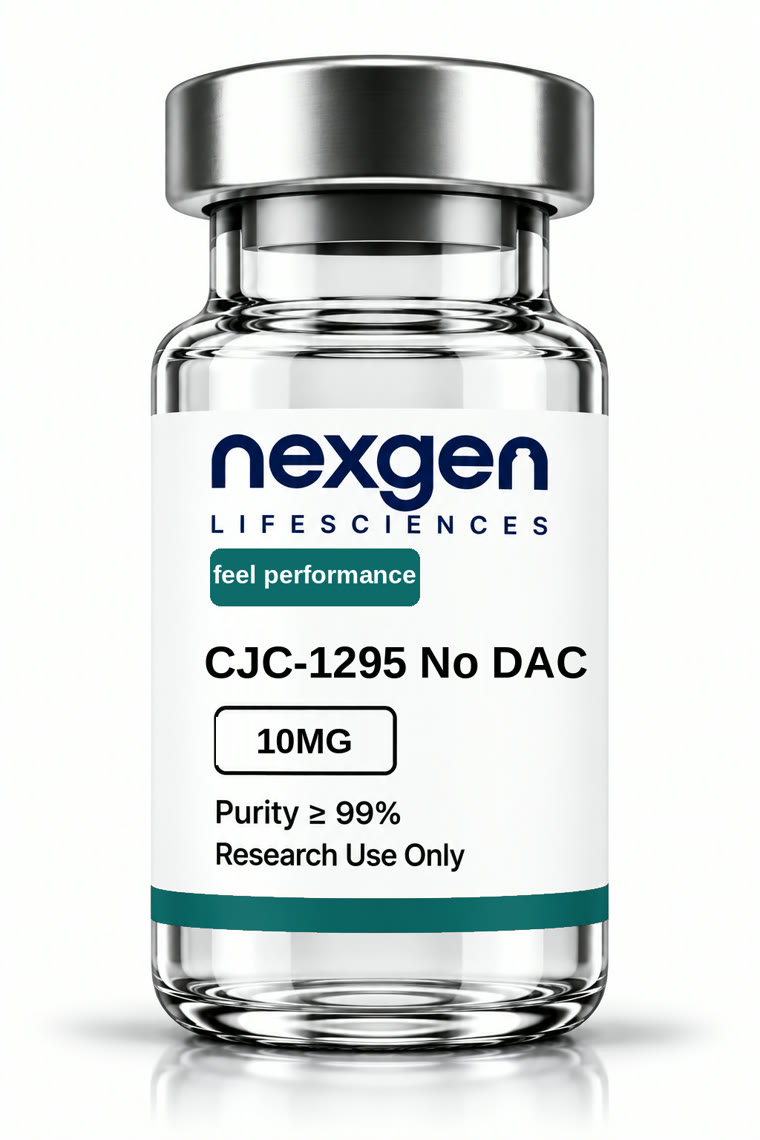
CJC-1295 (no DAC)
A stabilised version of the brain’s "release GH now" signal. It produces one natural-shaped pulse, then clears.
- Evidence
- DCommunity use what's this?
Grade D for this peptide. The mechanism is proven, but the human trials studied the DAC version. - Also known as
- Mod GRF 1-29 · Modified GRF (1-29) · CJC-1295 without DAC
- Class
- Short-acting synthetic analogue of growth hormone-releasing hormone (GHRH)
What it is
Your pituitary releases growth hormone in pulses, triggered by GHRH from the brain. Natural GHRH has 44 amino acids, but the first 29 carry all the activity. CJC-1295 is that 1–29 fragment with four amino-acid changes that resist breakdown and tighten binding.
There are two versions, and they aren’t interchangeable. Without DAC (this chapter) lasts about 30 minutes and produces a pulse. With DAC binds albumin and lasts 6–8 days, giving a sustained rise. Almost all the published human data belong to the DAC version. Neither is approved.
How it works
GH is meant to arrive in pulses. Keeping that rhythm is thought to avoid the receptor fatigue and constantly raised IGF-1 that come with sustained stimulation. It’s usually paired with a ghrelin mimetic such as Ipamorelin: the two push GH release through different receptors, so together they produce a bigger pulse than either alone.
What the research shows
The DAC version in healthy adults: single injections raised GH 2–10-fold for six days or more and IGF-1 1.5–3-fold for 9–11 days, with no serious adverse reactions1. Even under that continuous stimulation, GH release stayed pulsatile2.
The no-DAC version: the mechanism is well understood and it reliably produces a short GH pulse, but no dedicated human outcome trial has measured body composition, recovery or long-term effects. The class itself is proven: sermorelin (plain GRF 1–29) had FDA approval for GH-deficient children, and tesamorelin is approved today.
Evidence at a glance
| Use | Grade | Best evidence | Main gap | Read |
|---|---|---|---|---|
| Raises GH and IGF-1 | BHuman trials | GH 2–10×, IGF-1 1.5–3× (DAC version)1 | Data are the DAC variant | Class effect real |
| Keeps GH pulsatile | BHuman trials | Pulsatility preserved2 | DAC variant | Supports rationale |
| GHRH as a target | AApproved | Sermorelin and tesamorelin approved | Not this peptide | Mechanism proven |
| Recovery, body composition | DCommunity use | Community reports | No outcome trial | Plausible |
Dosing: what has been reported
| Setting | Figure | Route | Grade |
|---|---|---|---|
| Published (DAC only) | 30–60 mcg/kg, weekly-scale dosing1 | Subcutaneous | B |
| Clinic off-label | Low hundreds of mcg per injection, often with a ghrelin mimetic | Subcutaneous | C |
| Community | About 100 mcg per injection, 1–3 times daily, on an empty stomach, often at bedtime | Subcutaneous | D |
| Community stack | 100 mcg + 100 mcg Ipamorelin in one syringe | Subcutaneous | D |
DAC doses don’t carry over to the short-acting version. Around 100 mcg is treated as roughly saturating, so going higher mostly adds side effects. Avoid food, especially carbohydrates and fat, for about 30 minutes either side of the injection, because eating blunts the pulse.
Preparing & storing
Reconstitute with bacteriostatic water, refrigerate and don’t shake it. With daily use, a mixed vial is used up within its refrigerated window. Rotate injection sites.
Reported side effects
- Flushing or a head rush right after injection
- Tingling or numbness in the hands (a known GHRH-class effect)
- Injection-site reactions; drowsiness, often welcome at bedtime
- Water retention, joint aches and blood-sugar drift with heavy or prolonged use
Worth tracking: IGF-1, fasting glucose and insulin at baseline and after 6–12 weeks.
Who should avoid it
- Active or past cancer: IGF-1 is a growth signal
- Diabetes or insulin resistance, unless monitored
- Pregnancy and breastfeeding; pituitary disorders
- Tested athletes: WADA prohibited, both forms
Regulatory status checked Oct 2026
| Body | Status | Detail |
|---|---|---|
| FDA (US) | Not approved | Flagged in compounding review; related sermorelin and tesamorelin approved. |
| EMA (EU) | Not approved | No marketing authorisation. |
| CDSCO (India) | Not approved | No approval identified. |
| WADA | Prohibited | GHRH and analogues are banned at all times. |
A gentle nudge to the body’s own GH
CJC-1295 without DAC doesn’t add growth hormone. It asks your pituitary for a natural pulse, and the body’s own brake still applies. The mechanism is proven, but the outcome claims for this exact peptide are inferred, not measured.
References
- Teichman SL, Neale A, Lawrence B, et al. Prolonged stimulation of GH and IGF-I secretion by CJC-1295 in healthy adults. J Clin Endocrinol Metab. 2006;91(3):799–805. PMID 16352683 (DAC variant)
- Ionescu M, Frohman LA. Pulsatile secretion of GH persists during continuous stimulation by CJC-1295. J Clin Endocrinol Metab. 2006;91(12):4792–4797. PMID 17018654 (DAC variant)
- Sackmann-Sala L, Ding J, Frohman LA, Kopchick JJ. Activation of the GH/IGF-1 axis by CJC-1295 and serum protein profile changes. Growth Horm IGF Res. 2009;19(6):471–477.