
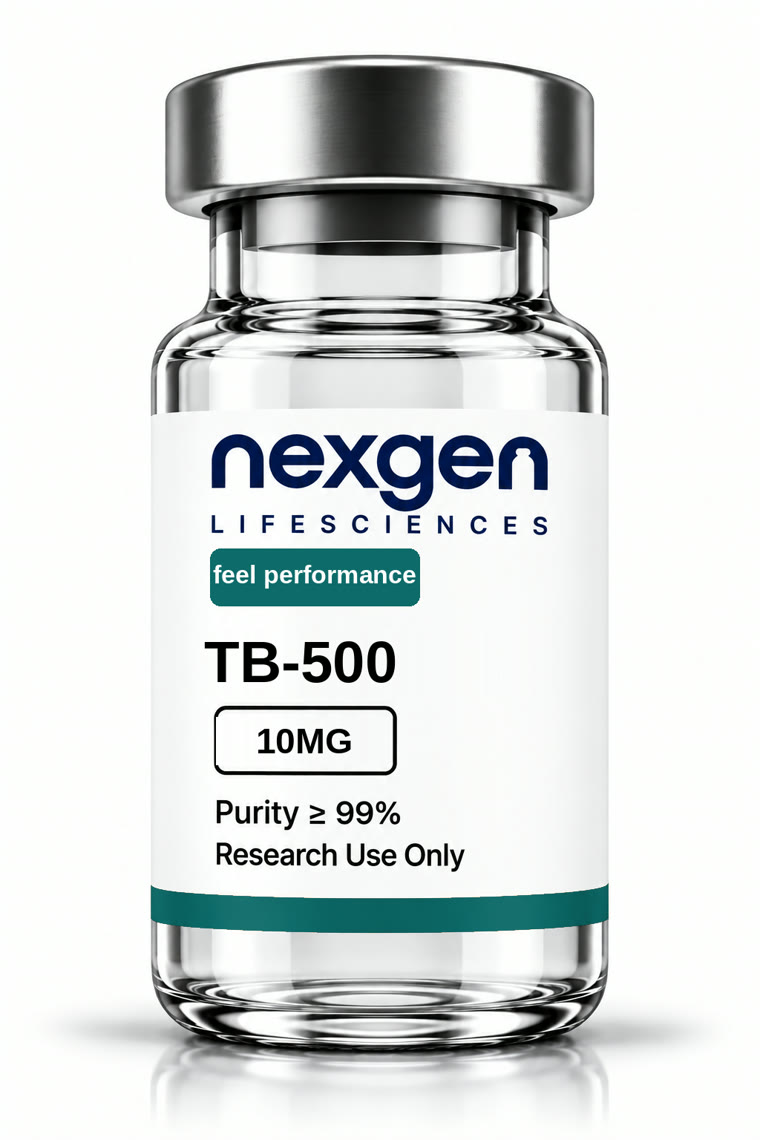
TB-500
BPC-157’s usual partner. It travels through the body to injured tissue and acts through the cell’s own skeleton.
- Evidence
- ELab & animal what's this?
Grade E for the injected fragment. Most human data are for the full parent protein. - Also known as
- Thymosin β4 fragment · Ac-LKKTETQ · Tβ4 fragment
- Class
- Synthetic heptapeptide, the actin-binding region of Thymosin Beta-4
What it is
Thymosin β4 (Tβ4) is a natural repair protein. Researchers traced much of its healing activity to a short region built around the motif LKKTETQ, and TB-500 is a synthetic copy of that fragment. The aim was the parent protein’s repair effects in a smaller, cheaper molecule. Whether the fragment does everything the full protein does, at the doses people inject, isn’t settled.
How it works
BPC-157 works mainly through nitric-oxide and growth-factor pathways, and TB-500 works through actin and cell migration. Because they cover different parts of repair, they’re commonly combined, and both appear in the GLOW and KLOW blends.
What the research shows
In people. The full Tβ4 protein reached advanced trials as topical products for dry eye (RGN-259) and chronic wounds (RGN-137), and an intravenous safety study in healthy volunteers found it well tolerated3. Cardiac-repair trials after heart attack were mixed. There are no completed human efficacy trials of injected TB-500 for musculoskeletal recovery.
In animals. Strong and replicated across independent labs. Tβ4 sped wound healing, angiogenesis, and cardiac and muscle repair through a consistent actin-based mechanism1,2.
Evidence at a glance
| Use | Grade | Best evidence | Main gap | Read |
|---|---|---|---|---|
| Soft-tissue repair | ELab & animal | Faster healing and angiogenesis in animals1,2 | Fragment untested in humans | Strong preclinical |
| Eye and wound (parent Tβ4) | BHuman trials | Human trials, well tolerated3 | Not the fragment | Useful context |
| Cardiac repair | ELab & animal | Strong in animals, mixed in humans | Did not translate cleanly | Cautionary |
| Injury recovery | DCommunity use | Community reports of benefit | No trial | Unproven |
Dosing: what has been reported
| Setting | Figure | Route | Grade |
|---|---|---|---|
| Published human (fragment) | None | — | — |
| Community, loading | 2–2.5 mg twice weekly for 4–6 weeks | SC or IM | D |
| Community, maintenance | 2–2.5 mg weekly or every 2 weeks | SC or IM | D |
| Community, daily split | ~700 mcg/day loading, ~350 mcg/day maintenance (same weekly total) | Subcutaneous | D |
The daily split lets people combine it with BPC-157 in one injection. Because TB-500 lasts a long time, twice-weekly dosing works just as well. Daily dosing is a convenience, not a requirement.
Preparing & storing
Reconstitute with bacteriostatic water, swirl gently, refrigerate and keep away from light. It acts systemically, so the injection doesn’t need to be near the injury. Rotate sites.
Reported side effects
- Brief tiredness or a head rush after injection
- Injection-site redness or a lump
- Occasional headache or mild nausea
- Theoretical: its pro-angiogenic action could feed an existing cancer
Who should avoid it
- Active, suspected or past cancer
- Pregnancy and breastfeeding (Tβ4 has roles in embryonic development)
- Blood thinners, clotting disorders or active heart disease (caution)
- Tested athletes: WADA prohibited (S2), detectable
Regulatory status checked Oct 2026
| Body | Status | Detail |
|---|---|---|
| FDA (US) | Not approved | Research compound; flagged in compounding review. |
| EMA (EU) | Not approved | No marketing authorisation. |
| CDSCO (India) | Not approved | No approval identified. |
| WADA | Prohibited | S2 peptide hormones and growth factors, at all times. |
Real repair biology, borrowed evidence
TB-500 has strong, replicated animal data and a sound mechanism, and the full parent protein has a clean human safety record. The injected fragment itself has never been tested in a human trial. Keep it away from any cancer history and out of tested sport.
References
- Goldstein AL, Hannappel E, Kleinman HK. Thymosin β4: actin-sequestering protein moonlights to repair injured tissues. Trends Mol Med. 2005;11(9):421–429.
- Bock-Marquette I, Saxena A, White MD, et al. Thymosin β4 activates integrin-linked kinase and promotes cardiac cell migration, survival and cardiac repair. Nature. 2004;432(7016):466–472.
- Full-length Tβ4 human programme: IV safety studies; topical trials in dry eye (RGN-259) and chronic wounds (RGN-137). Context for the parent protein, not the fragment.