
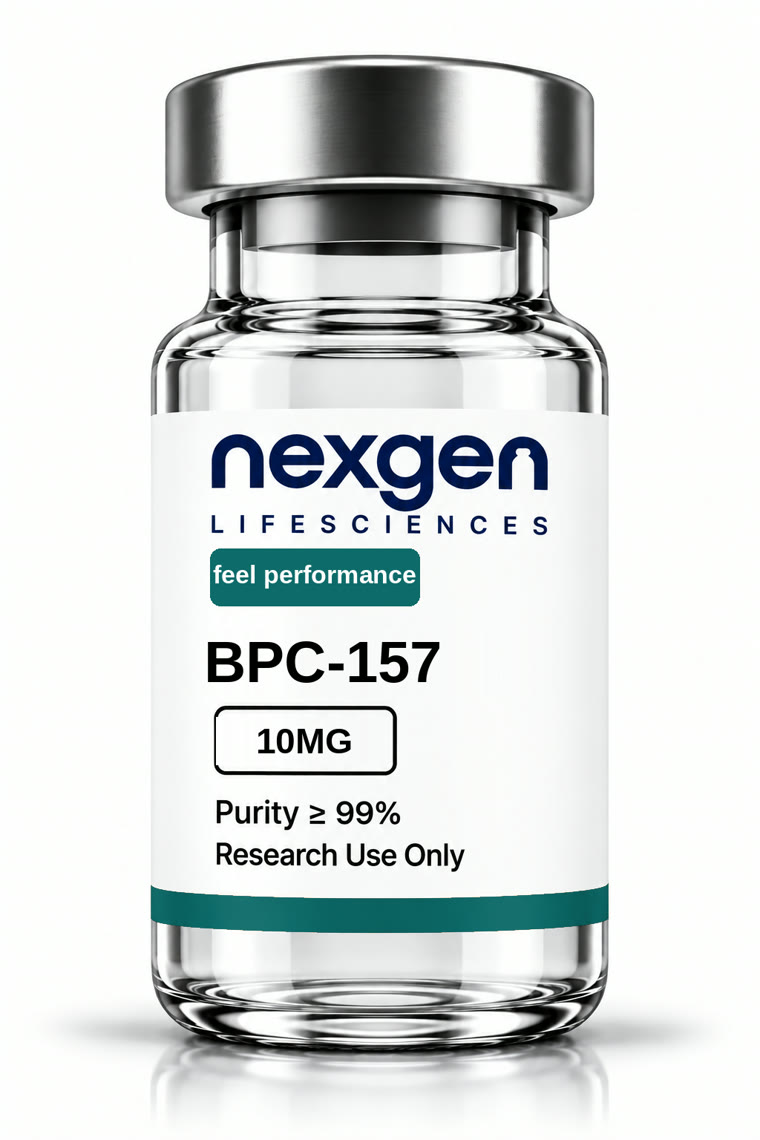
BPC-157
The most-discussed recovery peptide, built on decades of animal work and very little human data.
- Evidence
- ELab & animal what's this?
Grade E for efficacy. Hundreds of animal studies, and a handful of tiny human pilots. - Also known as
- Body Protection Compound-157 · Bepecin · PL 14736
- Class
- Synthetic 15-amino-acid peptide (GEPPPGKPADDAGLV) modelled on a protein in gastric juice
What it is
BPC-157 is a chain of fifteen amino acids. Researchers in Zagreb modelled it on part of a larger protective protein found in human gastric juice, which explains its unusual trait: it stays intact in stomach acid, where most peptides would be digested within minutes. The literature often calls it a stable gastric pentadecapeptide for that reason.
Work on it began with the gut, protecting the stomach and intestinal lining against damage. Over thirty years the focus has widened to tendon, ligament, muscle, bone and nerve. That body of work made it the best-known "healing peptide" in fitness circles. It is not approved as a medicine in any country.
How it works
BPC-157 doesn't act on one receptor. In animal and cell studies it touches several repair pathways at once, and all of them lead to the same place: getting blood, cells and collagen to damaged tissue.
There is also a nervous-system thread. Rodent studies show effects on dopamine and serotonin signalling, which researchers link back to its gut origin through the gut–brain axis. That work is early, and nobody has confirmed it in people.
What the research shows
In people. This is the weak point. A 2025 systematic review in HSS Journal screened 544 papers and kept 36. Thirty-five were preclinical. One was clinical: a small retrospective series of knee injections, in which 7 of 12 patients reported pain relief lasting more than six months1. The rest of the human record is a two-person intravenous safety pilot (doses up to 20 mg were tolerated and cleared from blood within a day) and a small bladder-instillation study for interstitial cystitis2. A Phase I safety trial was registered in 2015 but never published results3.
In animals. This is where BPC-157 is strong. In rats, mice and dogs it consistently improved healing of the Achilles and other tendons, ligaments, muscle and bone, with stronger and better-organised repaired tissue1. It also protected the gut against anti-inflammatory-drug damage and in colitis models. The results repeat across many injury types, but most come from one research group, and a rat tendon is not a human one.
In the lab. Cell studies support the mechanism above: blood-vessel growth, cell migration, more growth-hormone receptors and more collagen1,4.
Evidence at a glance
| Use | Grade | Best evidence | Main gap | Read |
|---|---|---|---|---|
| Tendon & ligament healing | ELab & animal | Faster, stronger healing across many animal models1 | Almost all rat data | Promising, unproven |
| Knee & joint pain | DCommunity use | 7 of 12 reported relief after a knee injection1 | Tiny, uncontrolled | Weak early signal |
| Gut protection | ELab & animal | Protected and healed the gut lining in animals | No human trial | Strong in animals |
| Human safety | BHuman trials | No adverse events in small pilots2 | A handful of people | Reassuring, minimal |
Dosing: what has actually been reported
| Setting | Figure | Route | Grade |
|---|---|---|---|
| Published human pilots | Single knee injection; IV up to 20 mg in a 2-person safety pilot2 | Intra-articular / IV | B isolated figures, not a schedule |
| Clinic off-label | Local injections near the injured site; no standard protocol | Local | C |
| Community, general | 250–500 mcg per day, cycles of 4–8 weeks | Subcutaneous | D |
| Community, gut | Similar or higher amounts by mouth | Oral | D |
Animal doses (roughly 10 ng to 10 µg per kg in rats) don't scale neatly to people, and the community figures don't come from any human dose-finding work. Treat them as context, not as a target.
Preparing & storing
Lyophilised (freeze-dried) BPC-157 is stable at room temperature for a short time, out of light, but long-term storage should be cold. Reconstitute it with bacteriostatic water by running the water down the inside of the vial, then swirl gently rather than shaking. Keep the mixed vial refrigerated at 2–8 °C. Its acid stability is the reason an oral form is plausible at all. See the mixing calculator for the arithmetic.
Reported side effects
- Injection-site redness, itch or a small lump (most common)
- Mild nausea, more often with oral use
- Headache or light-headedness early on
- Transient flushing or tiredness
- Rare reports of a racing heart. Stop and get assessed if this happens.
These come from pilots and anecdotes. Animal toxicity work found no lethal dose. The bigger unknown is long-term human safety, which has never been studied.
Who should avoid it
- Anyone with current or past cancer. Its main effect is growing new blood vessels, and tumours rely on new vessels too. Researchers have argued both sides and the question is unresolved.
- Pregnancy and breastfeeding (no data)
- Tested athletes: WADA prohibited (S0) since 2022
- Anyone on regular medication should get medical input first
Regulatory status checked Oct 2026
| Body | Status | Detail |
|---|---|---|
| FDA (US) | Not approved | Placed in the compounding "significant safety risk" category, so pharmacies can't compound it. Sold for research use only. |
| EMA (EU) | Not approved | No marketing authorisation. |
| CDSCO (India) | Not approved | No approval identified. |
| WADA | Prohibited | S0 non-approved substance, banned in and out of competition. |
Strong biology, thin human proof
BPC-157 has one of the most consistent animal records of any peptide, and the repair mechanism behind it is well mapped. What it lacks is a controlled human trial, plus long-term safety data and an answer to the question of whether it could feed tumours. Anyone using it is relying on animal data, so keep it away from any cancer history and out of tested sport.
References
- Vasireddi N, Hahamyan H, Salata MJ, et al. Emerging use of BPC-157 in orthopaedic sports medicine: a systematic review. HSS J. 2025;21(4):485–495. doi:10.1177/15563316251355551
- Regeneration or risk? A narrative review of BPC-157 for musculoskeletal healing. PMC12446177 (summarises the Lee & Padgett 2021 knee series, the Lee & Burgess 2025 IV pilot and an intravesical study).
- ClinicalTrials.gov. Safety and pharmacokinetics of Bepecin (BPC-157) in healthy volunteers. NCT02637284.
- From regeneration to analgesia: the role of BPC-157 in tissue repair and pain management. Int J Mol Sci. 2026;27(6):2876.