
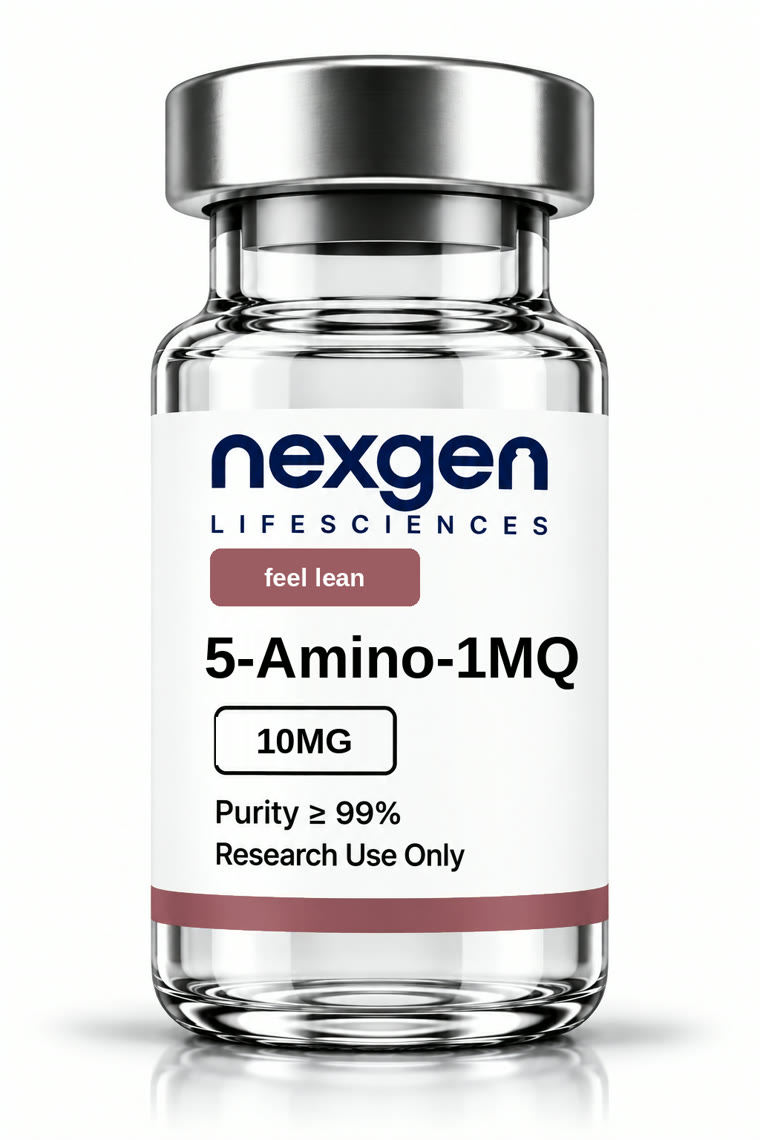
5-Amino-1MQ
A tiny enzyme blocker meant to push fat cells from storing energy toward burning it. So far it’s only been shown in cells and mice.
- Evidence
- ELab & animal what's this?
Grade E. No human study of any kind has been published. - Also known as
- 5A1MQ · 5-amino-1-methylquinolinium
- Class
- Small-molecule NNMT inhibitor (~159 Da). Not a peptide.
What it is
5-Amino-1MQ isn’t a peptide. It’s a small lab-made molecule, but it’s used the same way as peptides here, as a daily injectable in the fat-loss space. It has one job: to block NNMT (nicotinamide N-methyltransferase), an enzyme that becomes overactive in the fat tissue of people with obesity.
How it works
NNMT attaches a methyl group to nicotinamide (a form of vitamin B3), using SAM as the methyl donor. When the enzyme runs too hot, it drains nicotinamide that would otherwise be recycled into NAD+, and it uses up SAM. A fat cell short on NAD+ tends to store fat rather than burn it.
What the research shows
In people: nothing. No Phase 1, no pilot. Human pharmacokinetics are unpublished.
In animals: Kraus and colleagues showed that genetically switching off NNMT in mouse fat protected against diet-induced obesity1. That validated the target but didn’t test this drug. Neelakantan and colleagues then gave an inhibitor from this family to obese mice on a high-fat diet (20 mg/kg three times daily for 11 days). Body weight, fat mass, fat-cell size and cholesterol all fell, without the mice eating less2.
In the lab: in cultured fat cells, including human ones, blocking NNMT lowered 1-MNA, raised NAD+ and suppressed new fat building in a dose-dependent way.
Evidence at a glance
| Use | Grade | Best evidence | Main gap | Read |
|---|---|---|---|---|
| Fat loss in people | ELab & animal | Fat fell in obese mice without eating less2 | No human trial | Unproven |
| NNMT as a target | ELab & animal | Knockdown protected mice from obesity1 | Not the drug, not human | Promising |
| Longevity via NAD+ | ELab & animal | Preserves NAD+ precursor | No outcome data | Theory |
Dosing: what has been reported
| Setting | Figure | Route | Grade |
|---|---|---|---|
| Published human | None exists | — | — |
| Clinical | None established | — | — |
| Community, low band | 150–500 mcg/day | Subcutaneous | D |
| Community, high band | 2.5–5 mg/day | Subcutaneous | D |
The two community bands differ roughly tenfold, which shows how unsettled this is. The mouse dose of 20 mg/kg three times a day is an animal research figure. Never scale it up to a person.
Preparing & storing
Usually dissolves in bacteriostatic water. If a vial stays cloudy, a slightly acidic solvent helps. Keep the powder cool and dark, and refrigerate once mixed. No compound-specific stability data have been published, so follow the general rules conservatively.
Reported side effects
- Mild nausea, mostly early or on an empty stomach
- Transient headache in the first week
- Stimulant-like warmth, raised heart rate or jitters
- Insomnia if taken later in the day
- Injection-site stinging
- Occasional reports of TSH rising after 8–12 weeks (unvalidated)
All of these come from anecdotal reports and aren’t measured rates. If it’s used at all, sensible checks are glucose, lipids and a thyroid panel at baseline and after 8–12 weeks.
Who should avoid it
- Pregnancy and breastfeeding
- Anyone with a serious condition or on regular medication
- Known methylation issues (e.g. MTHFR variants): NNMT uses SAM, so get a clinician’s view
- Tested athletes: falls under WADA S0
Regulatory status checked Oct 2026
| Body | Status | Detail |
|---|---|---|
| FDA (US) | Not approved | Research-use-only small molecule; not controlled. |
| EMA (EU) | Not approved | No marketing authorisation. |
| CDSCO (India) | Not approved | No approval identified. |
| WADA | S0 likely | Not named; unapproved injectables fall under S0. |
An interesting target, with no human evidence yet
The biology is coherent and the mouse data are real but short. Nobody knows whether it works in people, or at what dose. Treat it as a research compound and use independently tested supply only.
References
- Kraus D, Yang Q, Kong D, et al. Nicotinamide N-methyltransferase knockdown protects against diet-induced obesity. Nature. 2014;508(7495):258–262. PMID 24717514
- Neelakantan H, Vance V, Wetzel MD, et al. Selective and membrane-permeable small molecule inhibitors of NNMT reverse high fat diet-induced obesity in mice. Biochem Pharmacol. 2018;147:141–152. PMID 29155147