
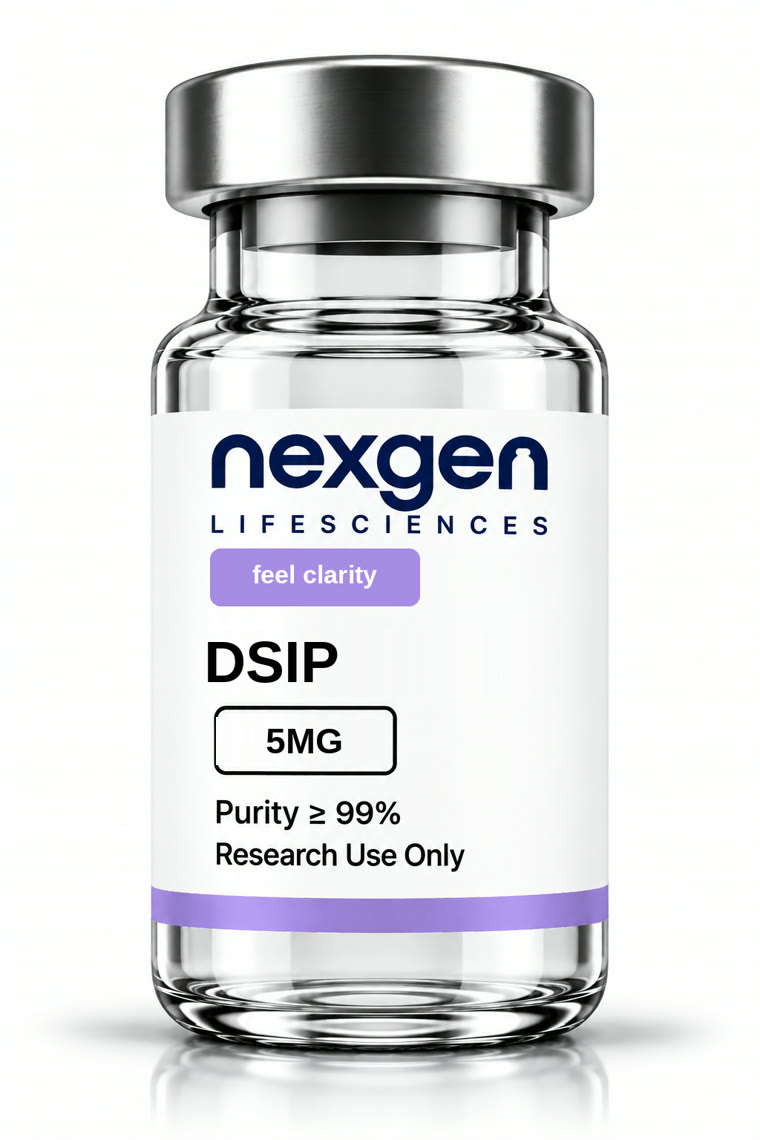
DSIP
Fifty years of study, still no agreed mechanism. A gentle sleep modulator, not a sedative.
- Evidence
- DCommunity use what's this?
Grade D for use. Human data exist but are old, small and mixed. - Also known as
- Delta Sleep-Inducing Peptide · Emideltide
- Class
- Naturally occurring nonapeptide; sleep and stress modulator
What it is
Swiss researchers named DSIP for its apparent effect: inducing delta-wave (deep, slow-wave) sleep. It occurs naturally in the brain, spinal fluid, blood and breast milk. It has been linked to sleep, stress, mood, withdrawal and cell protection, yet it’s studied more than almost any peptide here and understood less. It isn’t approved anywhere.
How it seems to work
It’s thought to interact with NMDA and GABA signalling. Because evening cortisol often keeps people awake, calming the stress axis may be part of how it helps sleep.
What the research shows
In people: studies since the late 1970s showed effects on sleep architecture, better in disturbed sleepers and minimal in good ones2. It blunted the cortisol and ACTH response to stress1. Small, often uncontrolled pilots reported milder opiate withdrawal. No large modern randomised trial exists. In animals: broad. It promoted delta sleep in rabbits, rats and mice, and showed anti-stress, antioxidant, anticonvulsant and neuroprotective effects.
Evidence at a glance
| Use | Grade | Best evidence | Main gap | Read |
|---|---|---|---|---|
| Disturbed sleep | BHuman trials | Modulates sleep; better when disturbed2 | Old, small, mixed | Gentle modulator |
| Stress buffering | BHuman trials | Blunts cortisol/ACTH response1 | Dated | Real signal |
| Opiate withdrawal | BHuman trials | Reduced severity in pilots | Small, uncontrolled | Preliminary |
| Neuroprotection | ELab & animal | Animal models | Animal only | Speculative |
Dosing: what has been reported
| Setting | Figure | Route | Grade |
|---|---|---|---|
| Published human (dated) | ~25 nmol/kg IV, roughly a couple of hundred mcg, in clinic2 | IV | B |
| Community | 100–300 mcg, as needed, 30–60 min before bed or during the day | Subcutaneous | D |
No fasting needed. Because of the U-shaped response, the low-to-middle of the range often works better than the top.
Preparing & storing
Reconstitute with bacteriostatic water and refrigerate. No unusual handling quirks.
Reported side effects
- Occasional mild headache
- Grogginess at higher doses
- Uncommon mild dizziness; injection-site redness
- Less effect at high doses (the U-curve)
The old human studies reported no major adverse effects. Track sleep quality and stress subjectively.
Who should avoid it
- Pregnancy and breastfeeding
- Sleep, sedative or psychiatric medication: get medical input first
- Anyone expecting a strong sedative
Regulatory status checked Oct 2026
| Body | Status | Detail |
|---|---|---|
| FDA (US) | Not approved | Never approved despite decades of study. |
| EMA (EU) | Not approved | — |
| CDSCO (India) | Not approved | — |
| WADA | Not named | S0 could apply. |
Subtle, old and unsolved
DSIP has a real but dated human signal for disturbed sleep and stress. It’s well tolerated and gentle, and genuinely mysterious. Use the lower end of the range and judge it over a week of nights, not one.
References
- Graf MV, Kastin AJ. Delta-sleep-inducing peptide (DSIP): a review. Neurosci Biobehav Rev. 1984;8(1):83–93. PMID 6145137
- Delta sleep-inducing peptide. Eur J Anaesthesiol. 2001;18(7):427–440. (Review of its sleep-promoting rather than sedative profile.)