
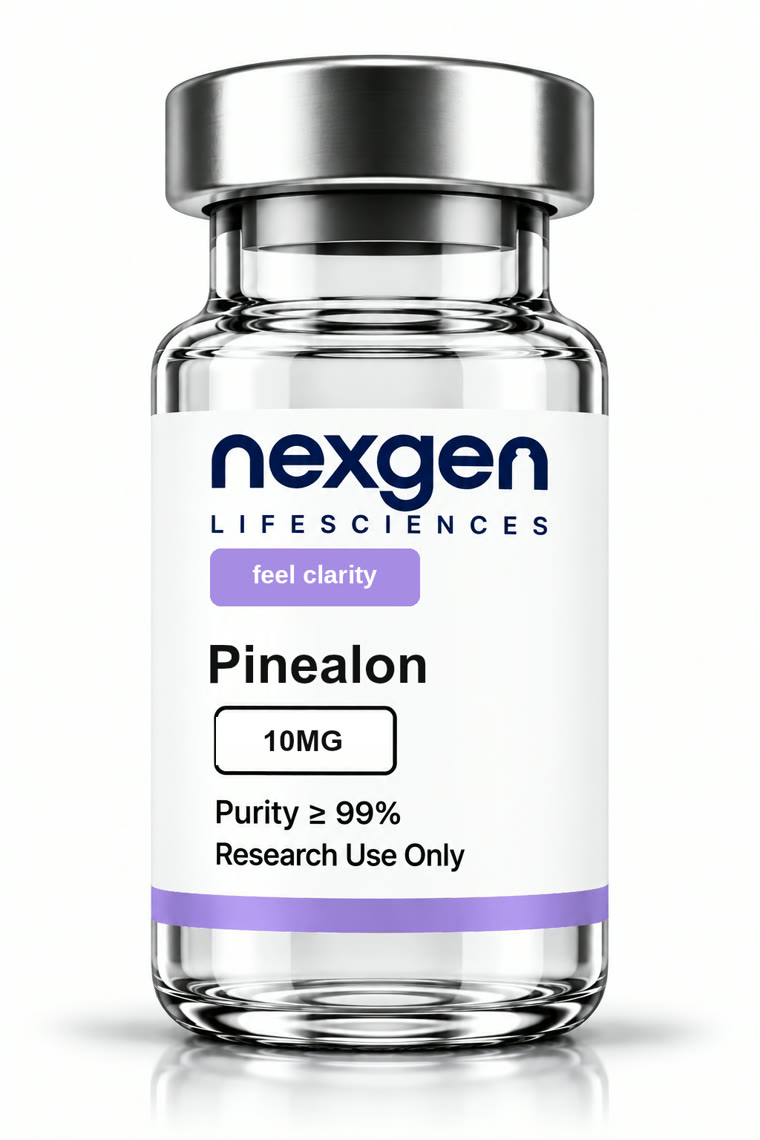
Pinealon
The brain member of the bioregulator family. Despite the name, it came from brain cortex, not the pineal gland.
- Evidence
- ELab & animal what's this?
Grade E. Cell and animal data from one research lineage; no independent human trials. - Also known as
- EDR peptide · Glu-Asp-Arg
- Class
- Synthetic tripeptide Khavinson bioregulator, neuron-directed
What it is
Pinealon is a cousin of Epitalon and Cartalax in the St Petersburg bioregulator family. It was derived from brain cortex extract, and the name reflects its proposed target rather than its source. Epitalon works upstream on the pineal and body clock. Pinealon is pitched as working downstream, protecting the neuron itself.
How it’s proposed to work
What the research shows
In the lab: the cleanest data. In cultured brain cells, Pinealon reduced reactive oxygen species and cell death in a dose-dependent way under oxidative and excitotoxic stress, and restored dendritic spines1,2. In animals: neuroprotection and better learning-task performance in rodents2,3, from the same lineage. In people: one small trial in traumatic brain injury, using a low oral dose, from the same group. No independent efficacy trials.
Evidence at a glance
| Use | Grade | Best evidence | Main gap | Read |
|---|---|---|---|---|
| Neuroprotection | ELab & animal | Less ROS and cell death1,2 | Cell level, single lineage | Preliminary |
| Memory | ELab & animal | Better rodent learning; spines restored2 | Animal only | Unproven |
| Human benefit | BHuman trials | One small TBI trial | Not independent | Essentially unproven |
Dosing: what has been reported
| Setting | Figure | Route | Grade |
|---|---|---|---|
| Published human | ~0.2 mg twice daily (TBI study) | Oral | B |
| Community, oral | ~20 mg/day for 20–30 days, 2–3 times a year | Oral | D |
| Community, injectable | ~1–5 mg/day in short courses | Subcutaneous | D |
There’s a large gap between the trial dose and community doses, which shows how unsettled dosing is.
Preparing & storing
For injection, reconstitute with bacteriostatic water and refrigerate. The open question is how much survives in the body and reaches the brain.
Reported side effects
- Mild injection-site redness
- Occasional mild headache
- Most reports describe minimal noticeable effect
Who should avoid it
- Pregnancy and breastfeeding
- Psychiatric or seizure medication: get medical input
- Serious neurological conditions: use proper care, not a research peptide
Regulatory status checked Oct 2026
| Body | Status | Detail |
|---|---|---|
| FDA (US) | Not approved | Not on the permissible compounding list. |
| EMA (EU) | Not approved | — |
| CDSCO (India) | Not approved | Registered as a bioregulator in its country of origin. |
| WADA | Not named | S0 could apply. |
Interesting cell data, little else
Pinealon’s neuron-protection results in the lab are real. Everything beyond that comes from one research group and hasn’t been tested in independent human trials. Treat it as experimental.
References
- Khavinson VKh, et al. Short peptides upregulate antioxidant and neuroprotective gene expression and reduce oxidative cell death in neuronal cultures. Rejuvenation Res. 2011. PMID 21978084
- EDR peptide neuroprotective mechanism: reduced caspase-3 and p53, increased neuronal viability. PMC7795577
- Khavinson VKh. Peptide regulation of gene expression and the bioregulator framework. 2009. PMID 19830583