
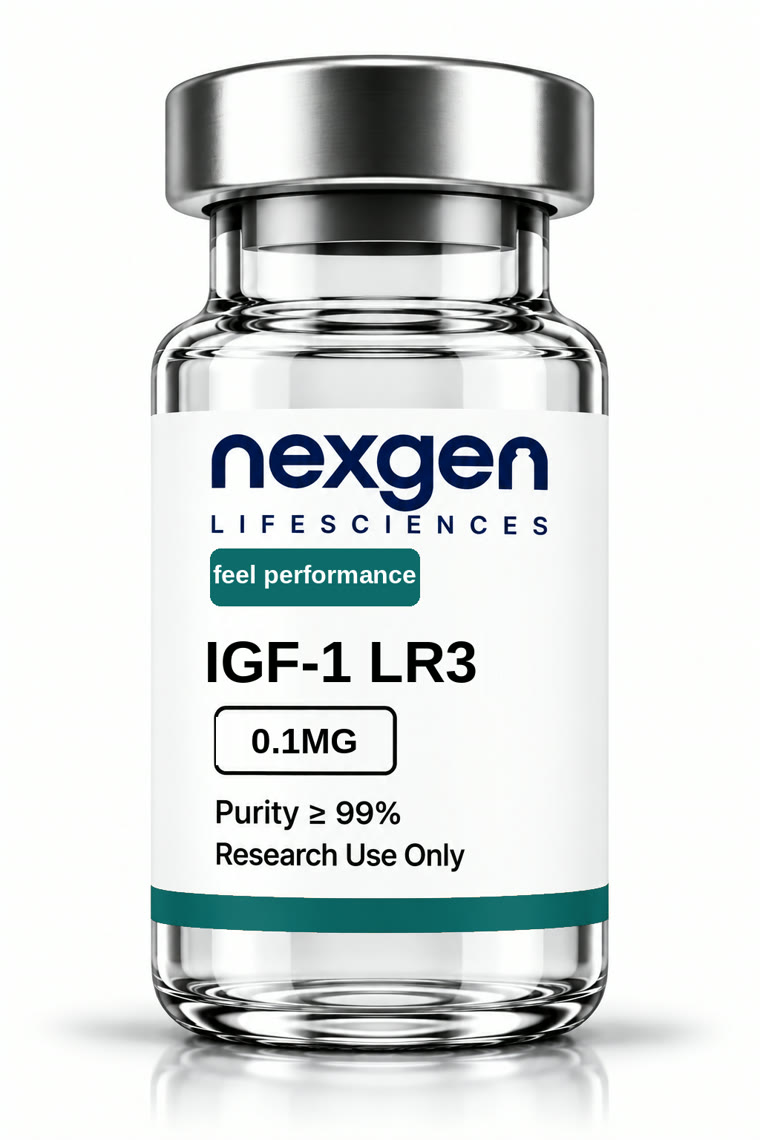
IGF-1 LR3
A supercharged version of the growth factor GH works through. It is potent, long-acting and unforgiving if you dose it fasted.
- Evidence
- DCommunity use what's this?
Grade D. The IGF-1 mechanism is proven through mecasermin, but LR3 itself has almost no human data. - Also known as
- Long R3 IGF-1 · Insulin-like Growth Factor 1 Long Arg3
- Class
- Synthetic long-acting analogue of IGF-1 (83 amino acids)
What it is
Much of what growth hormone does, it does through IGF-1 made in the liver. Natural IGF-1 lasts only 12–15 minutes, because carrier proteins (IGFBPs) grab it. LR3’s modifications stop that binding, so it stays active for roughly 20–30 hours and hits harder per dose. Unmodified IGF-1 is approved as mecasermin (Increlex) for children with severe IGF-1 deficiency. LR3 is the bodybuilding analogue: not approved and barely studied in peer-reviewed work.
How it works
What the research shows
For LR3 itself: almost nothing in humans. It was developed as a potent cell-culture reagent, which is where its characterisation comes from. For the IGF-1 mechanism: mecasermin has real trial and registry data showing it restores growth in severe IGF-1 deficiency, and it clearly documents the side effects, especially hypoglycaemia1,2,3.
Evidence at a glance
| Use | Grade | Best evidence | Main gap | Read |
|---|---|---|---|---|
| IGF-1 mechanism | AApproved | Mecasermin restores growth1,3 | Native IGF-1, not LR3 | Proven |
| Muscle growth (LR3) | DCommunity use | Community reports | No human trial | Plausible |
| Hyperplasia | ELab & animal | Satellite-cell activation possible | Not shown in humans | Speculative |
| Long-term safety | ELab & animal | None for LR3 | Cancer and glucose concerns | Unknown |
Dosing: what has been reported
| Setting | Figure | Route | Grade |
|---|---|---|---|
| Approved native IGF-1 | Mecasermin 40–80 mcg/kg twice daily, max 120 mcg/kg, always with a meal1 | Subcutaneous | A |
| Community, beginner | 10–20 mcg/day, 4–6-week cycles | SC or IM | D |
| Community, common | 20–50 mcg/day, after training with food | SC or IM | D |
| Community, advanced | 50–100 mcg/day: higher risk, little extra benefit | SC or IM | D |
Three rules apply to all community protocols: always dose with or straight after a carbohydrate meal, never fasted; never before bed, because low blood sugar during sleep is hard to catch; and cap cycles at 4–6 weeks, because continuous use downregulates the receptor. Keep a glucose meter on hand.
Preparing & storing
Reconstitute with bacteriostatic water. Some prefer dilute acetic acid for better stability. It’s more delicate than small peptides: store the powder cold, refrigerate once mixed and never shake it.
Reported side effects
- Hypoglycaemia: shakiness, sweating, confusion; worst when dosed fasted or at night
- Water retention and puffiness
- Joint pain at higher doses; headaches
- Injection-site reactions
- Excess dosing: unwanted tissue or organ growth (an acromegaly-like concern)
- Long term: insulin resistance and a theoretical cancer risk
Who should avoid it
- Active or past cancer (strongly)
- Diabetes or a tendency to low blood sugar
- Insulin users: the most dangerous combination
- Proliferative eye disease; pregnancy and breastfeeding
- Tested athletes: WADA prohibited, detectable
Regulatory status checked Oct 2026
| Body | Status | Detail |
|---|---|---|
| FDA (US) | Not approved | Research chemical; native IGF-1 (mecasermin) approved for a narrow deficiency. |
| EMA (EU) | Not approved | Mecasermin approved; LR3 is not. |
| CDSCO (India) | Not approved | No approval identified for the analogue. |
| WADA | Prohibited | IGF-1 and analogues are banned at all times. |
Potent, and its potency is the risk
IGF-1 LR3 is the strongest anabolic signal in this section. It also comes with an immediate hypoglycaemia risk, a long-term cancer question and no human safety data of its own. It is not for beginners, fasted dosing or anyone with a cancer history.
References
- Increlex (mecasermin) prescribing information. FDA-approved 2005 for severe primary IGF-1 deficiency.
- Bang P, Polak M, Woelfle J, Houchard A. Effectiveness and safety of rhIGF-1 therapy in children: the European Increlex Growth Forum Database. Horm Res Paediatr. 2015;83(5):345–357.
- Profile of mecasermin for long-term treatment of growth failure in severe primary IGF-1 deficiency. PMC2724186.