
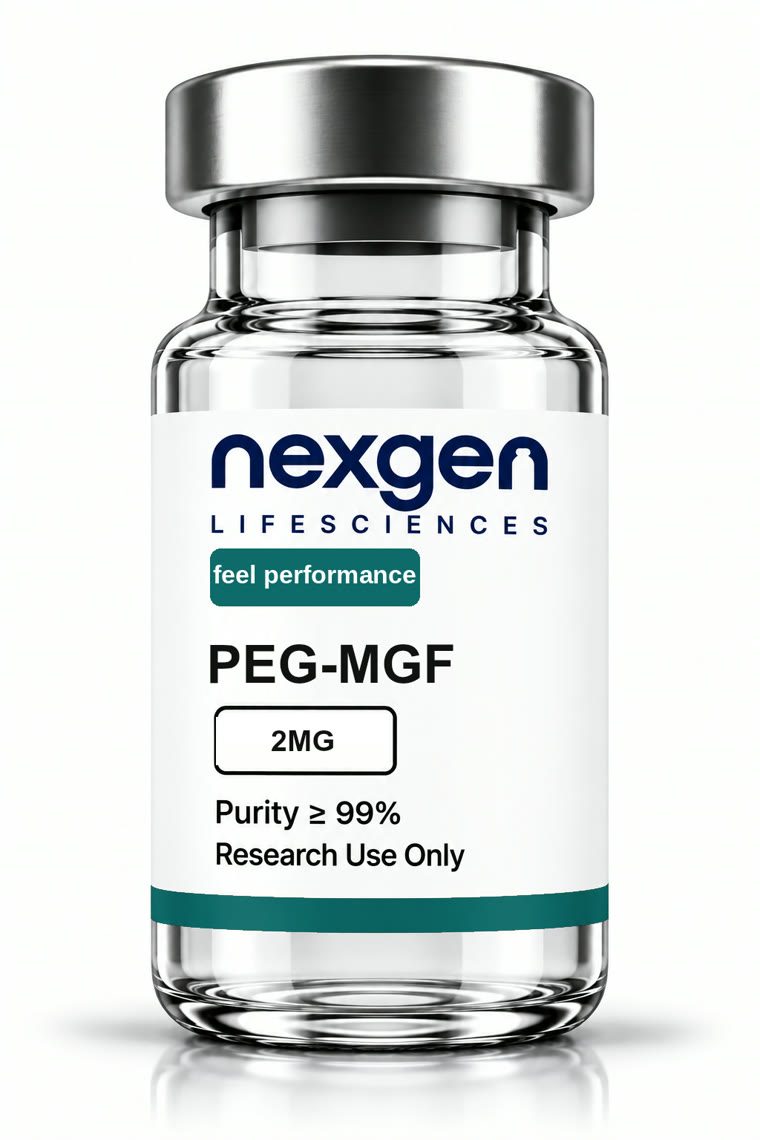
PEG-MGF
A longer-lasting copy of the repair signal your muscle makes after hard training.
- Evidence
- ELab & animal what's this?
Grade E for the injected compound. Human data only show that muscle makes natural MGF after exercise. - Also known as
- PEGylated Mechano Growth Factor · IGF-1Ec · MGF E-domain peptide
- Class
- Synthetic PEGylated peptide based on a local IGF-1 splice variant
What it is
When training causes micro-damage, the muscle reads the IGF-1 gene differently and makes its own local repair molecule, mechano growth factor (IGF-1Ec in humans), which has a distinctive E-domain tail. Unlike liver IGF-1, MGF is made and used on the spot. Native MGF lasts only 5–7 minutes. Attaching polyethylene glycol (PEGylation) keeps it active for hours to days, which makes it practical to inject.
How it works
Unlike IGF-1 LR3, MGF acts locally on satellite cells and doesn’t have IGF-1’s whole-body insulin-like effects, so it carries little hypoglycaemia risk. That’s why the community runs it first (activate), then IGF-1 (build), copying the body’s own order.
What the research shows
In people: human muscle makes MGF after heavy resistance exercise, and the response is blunted in older muscle1. That confirms its role, but it doesn’t test injection. In animals and cells: mostly from the Goldspink lab that discovered it. MGF activates and multiplies satellite cells and supports repair and hypertrophy, separately from mature IGF-12,3. Animal work also hints at benefits for tendon, heart and nerve tissue.
Evidence at a glance
| Use | Grade | Best evidence | Main gap | Read |
|---|---|---|---|---|
| Natural MGF in muscle | BHuman trials | Made after resistance training1 | Own MGF, not injected | Real biology |
| Satellite-cell activation | ELab & animal | Activates and multiplies them2,3 | Preclinical | Well mapped |
| Injected muscle growth | DCommunity use | Community reports | No human trial | Unproven |
Dosing: what has been reported
| Setting | Figure | Route | Grade |
|---|---|---|---|
| Published human | None | — | — |
| Community, PEG-MGF | 200–500 mcg once or twice weekly, after training | SC or IM | D |
| Community, native MGF | ~200 mcg immediately after training (minutes-long half-life) | SC or IM, local | D |
Post-workout timing lines up with the natural window when muscle activates satellite cells. Without the training stimulus there’s little for it to act on.
Preparing & storing
Reconstitute with bacteriostatic water, refrigerate and don’t shake. PEGylation makes it much more stable than native MGF.
Reported side effects
- Injection-site soreness, redness or a lump
- Occasional mild fatigue or headache
- Anti-PEG antibodies with repeated dosing, which can clear it faster and weaken the effect
- No meaningful drop in blood sugar (unlike IGF-1 LR3)
Who should avoid it
- Active or past cancer (IGF-1 receptor pathway)
- Known PEG allergy
- Pregnancy and breastfeeding
- Tested athletes: WADA prohibited growth factor
Regulatory status checked Oct 2026
| Body | Status | Detail |
|---|---|---|
| FDA (US) | Not approved | Research compound. |
| EMA (EU) | Not approved | No marketing authorisation. |
| CDSCO (India) | Not approved | No approval identified. |
| WADA | Prohibited | IGF-1-related growth factor; banned at all times. |
The body’s first repair signal, extended
PEG-MGF copies the opening step of muscle repair, and the biology is real. Whether injecting it adds anything beyond what hard training already triggers hasn’t been tested in people.
References
- Hameed M, Orrell RW, Cobbold M, Goldspink G, Harridge SDR. Expression of IGF-I splice variants in young and old human skeletal muscle after high resistance exercise. J Physiol. 2003;547(1):247–254.
- Goldspink G. Mechanical signals, IGF-I gene splicing, and muscle adaptation. Physiology. 2005;20:232–238.
- Chargé SBP, Rudnicki MA. Cellular and molecular regulation of muscle regeneration. Physiol Rev. 2004;84(1):209–238.