
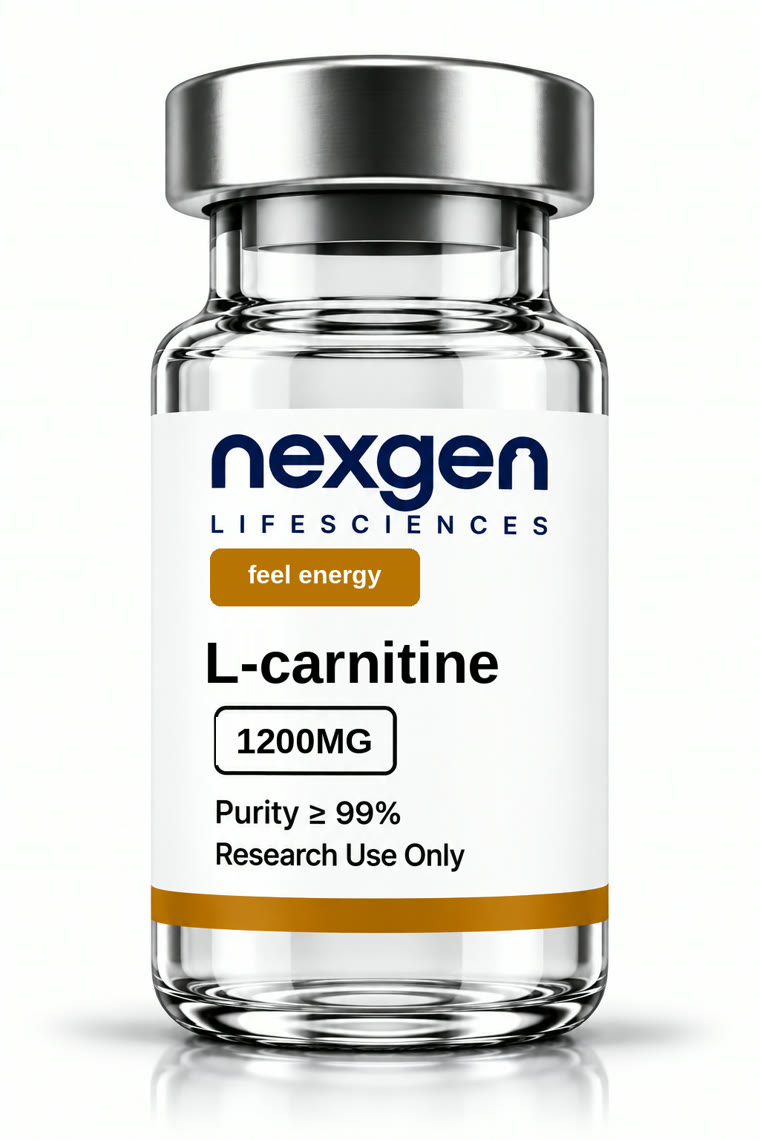
L-Carnitine
The ferry that carries fat into the cell’s furnace. In a healthy person, though, the ferry usually isn’t the bottleneck.
- Evidence
- AApproved what's this?
Grade A for carnitine deficiency. Grade B but weak for fat loss in healthy people. - Also known as
- Levocarnitine · L-carnitine L-tartrate
- Class
- Naturally occurring amino-acid derivative; mitochondrial fatty-acid transporter. Not a peptide.
What it is
L-carnitine is included because it’s widely injected in fat-loss and performance settings and often stacked with peptides. Its job is real: long-chain fats can’t enter the mitochondria without it. That’s why it’s marketed as a fat burner, and why it’s a good example of the gap between a real mechanism and a proven benefit.
How it works
What the research shows
Deficiency: injectable levocarnitine treats primary and secondary deficiency, including in dialysis, because those people really are short of it. Fat loss in healthy people: weak and inconsistent. Carnitine alone doesn’t produce weight loss in normal-weight people, and controlled work found no change in how much fat was burned during exercise3. Some meta-analyses in overweight people show about a kilogram, alongside diet. Recovery: more favourable but mixed. Several studies report less muscle damage and soreness1,2.
Evidence at a glance
| Use | Grade | Best evidence | Main gap | Read |
|---|---|---|---|---|
| Carnitine deficiency | AApproved | Corrects genuine deficiency | Only if deficient | Proven medicine |
| Fat loss, healthy | BHuman trials | Little to no effect alone3 | Not the rate-limiting step | Weak |
| Exercise recovery | BHuman trials | Less damage, faster recovery1 | Inconsistent | Modest support |
| Performance | BHuman trials | Mixed2 | Hard to raise muscle levels | Uncertain |
Dosing: what has been reported
| Setting | Figure | Route | Grade |
|---|---|---|---|
| Approved (deficiency) | ~50 mg/kg IV (adjusted), or 10–20 mg/kg after each dialysis | IV | A |
| Clinic | 500–2,000 mg (usually 500–1,000 mg), weekly or more, with diet and training | Intramuscular | D |
| Community | 500–1,000 mg, up to 2,000 mg, several times weekly to daily | Intramuscular | D |
| Oral (comparison) | 1–3 g/day, often 2 g | Oral | B |
Inject into a large muscle (glute, thigh, deltoid), not belly fat, where it stings. It usually comes as a ready-made solution, not a powder.
Reported side effects
- Injection-site pain, stinging or swelling
- Nausea, cramps or diarrhoea (more with oral use)
- Fishy body odour at high doses (trimethylamine); reverses when the dose is lowered
- Rare: seizures in people with a seizure disorder
- Long-term: gut bacteria turn some into TMAO, which is debated as a cardiovascular risk
Who should avoid it
- Seizure disorders
- Hypothyroidism or thyroid treatment: it can blunt thyroid hormone action
- Warfarin users (it may enhance the effect); valproate depletes carnitine
- Significant cardiovascular disease: discuss the TMAO question
Regulatory status checked Oct 2026
| Body | Status | Detail |
|---|---|---|
| FDA (US) | Approved (deficiency) | Injectable levocarnitine; oral as supplement. |
| EMA (EU) | Approved (deficiency) | — |
| CDSCO (India) | Available | Levocarnitine available. |
| WADA | Not prohibited | But IV infusions over 100 mL / 12 h breach the method rule. |
Real medicine for deficiency, a weak fat burner
Carnitine helps when you’re low, after hard training, and possibly more on plant-based diets. For fat loss in a healthy person, it supports diet and training at best and can’t replace them.
References
- Fielding R, Riede L, Lugo JP, Bellamine A. L-Carnitine supplementation in recovery after exercise. Nutrients. 2018;10(3):349.
- Effect of acute and chronic oral L-carnitine supplementation on exercise performance: a systematic review. PMC8704793
- Broad EM, Maughan RJ, Galloway SDR. Carbohydrate, protein and fat metabolism during exercise after oral carnitine supplementation. Int J Sport Nutr Exerc Metab. 2008. PMID 19164828