
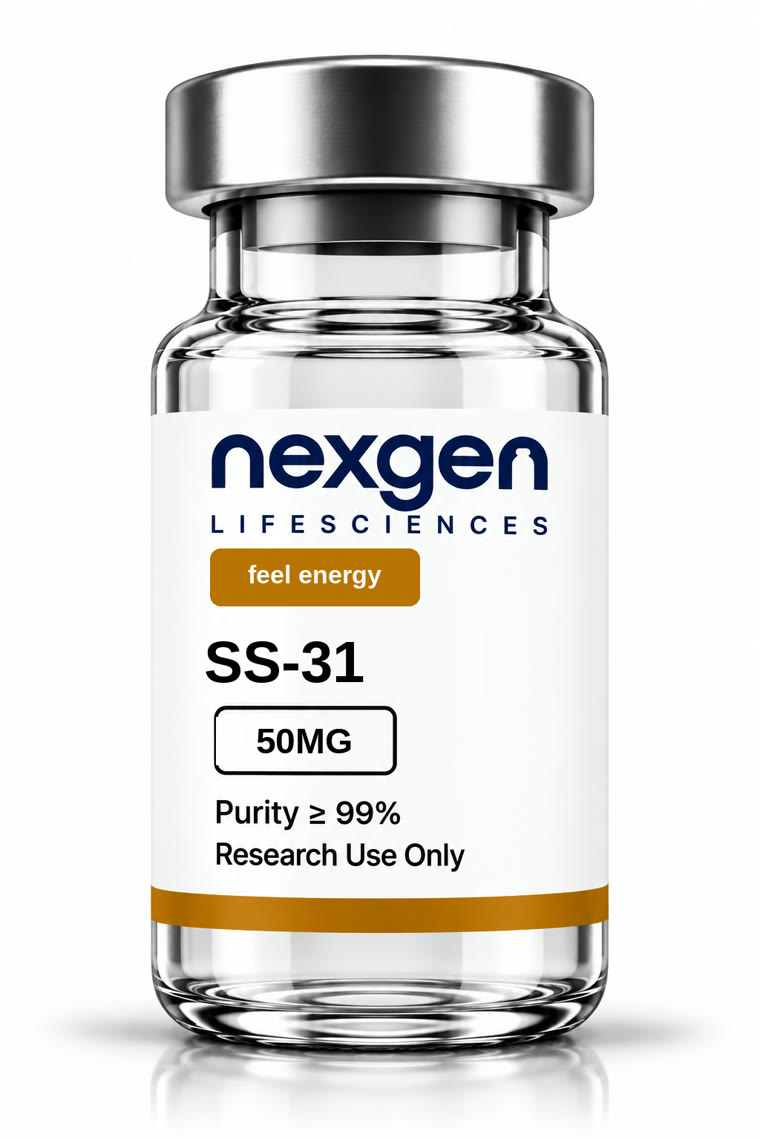
SS-31
The first mitochondria-targeting peptide the FDA has approved. It protects the membrane where energy is made.
- Evidence
- AApproved what's this?
Grade A for Barth syndrome (Sept 2025). Positive renal pilot; broader trials largely missed. - Also known as
- Elamipretide · MTP-131 · Bendavia · Forzinity
- Class
- Mitochondria-targeted aromatic-cationic tetrapeptide. Approved for Barth syndrome.
What it is
SS-31 has one of the most elegant mechanisms in this guide and a deep preclinical record across heart, kidney, muscle and ageing. In large human trials it repeatedly missed its primary endpoints. Its one approval, as Forzinity in September 2025, is for Barth syndrome, an inherited cardiolipin disorder. Every other use is investigational.
How it works
Unlike many mitochondrial antioxidants, it gets in without needing membrane charge, so it keeps working when charge collapses during injury. That’s exactly when protection matters.
What the research shows
Barth syndrome: TAZPOWER and its extension showed functional gains, especially muscle strength, which led to accelerated approval3. Kidney: in a Phase 2a trial during stent revascularisation for renal artery stenosis, kidney hypoxia rose 47% on placebo but fell 6% on elamipretide, and renal blood flow was higher at three months4. Elsewhere: the Phase 3 in mitochondrial myopathy missed its primary endpoints, heart-failure results were modest, and dry macular degeneration was mixed. In animals: it sped ATP recovery after kidney ischaemia, protected tubules and prevented progression from acute injury to chronic kidney disease5. It also reversed mitochondrial damage in heart, brain and ageing-muscle models1,2.
Evidence at a glance
| Use | Grade | Best evidence | Main gap | Read |
|---|---|---|---|---|
| Barth syndrome | AApproved | Muscle-strength improvement3 | Confirmatory trial pending | Approved |
| Renal protection (human) | BHuman trials | Less hypoxia, more flow4 | Small pilot | Promising |
| Kidney injury (animal) | ELab & animal | Prevented acute-to-chronic progression5 | Preclinical | Strong |
| Heart failure, myopathy | BHuman trials | Missed primary endpoints | Largely negative | Disappointing |
| General longevity | DCommunity use | Extrapolated | Not tested in healthy people | Speculative |
Dosing: what has been reported
| Setting | Figure | Route | Grade |
|---|---|---|---|
| Approved (Barth) | ~40 mg once daily, weight-based | Subcutaneous | A |
| Trials, SC | 0.1–2 mg/kg daily | Subcutaneous | B |
| Trials, IV | Heart failure 0.01–0.25 mg/kg/h over ~4 h; renal pilot 0.05 mg/kg/h during the procedure | IV | B |
| Community | ~5–20 mg/day, often cycled | Subcutaneous | D |
Research vials are not the approved drug product, so identity and purity depend entirely on the supplier’s testing.
Preparing & storing
Reconstitute with bacteriostatic water, refrigerate and don’t shake. There’s usually no immediately felt effect, because it protects mitochondria rather than stimulating.
Reported side effects
- Injection-site reactions: redness, pain, itching, swelling, bruising, hives
- Occasional headache
- Otherwise well tolerated across a large trial programme
Who should avoid it
- Pregnancy and breastfeeding
- Serious heart, kidney or muscle disease: get specialist care, not self-treatment
Regulatory status checked Oct 2026
| Body | Status | Detail |
|---|---|---|
| FDA (US) | Approved (Barth) | Forzinity, Sept 2025; accelerated approval. |
| EMA (EU) | Not approved | — |
| CDSCO (India) | Not approved | — |
| WADA | Not listed | IV over 100 mL / 12 h falls under the infusion rule. |
Beautifully targeted, narrowly proven
SS-31 protects mitochondria where it matters, and its safety record is reassuring. The kidney signal stands out. For general ageing, the human trials have mostly not delivered the benefit the mechanism promises.
References
- Szeto HH. First-in-class cardiolipin-protective compound to restore mitochondrial bioenergetics. Br J Pharmacol. 2014;171(8):2029–2050.
- Szeto HH, Birk AV. Serendipity and the discovery of novel compounds that restore mitochondrial plasticity. Clin Pharmacol Ther. 2014;96(6):672–683.
- Reid Thompson W, et al. Elamipretide in Barth syndrome (TAZPOWER). Genet Med. 2021;23(3):471–478. FDA accelerated approval of Forzinity, 19 Sept 2025.
- Saad A, Herrmann SMS, Eirin A, et al. Phase 2a trial of elamipretide during stent revascularization in atherosclerotic renal artery stenosis. Circ Cardiovasc Interv. 2017;10(9):e005487.
- Szeto HH, Liu S, Soong Y, et al. Mitochondria-targeted peptide accelerates ATP recovery and reduces ischemic kidney injury. J Am Soc Nephrol. 2011;22(6):1041–1052.