
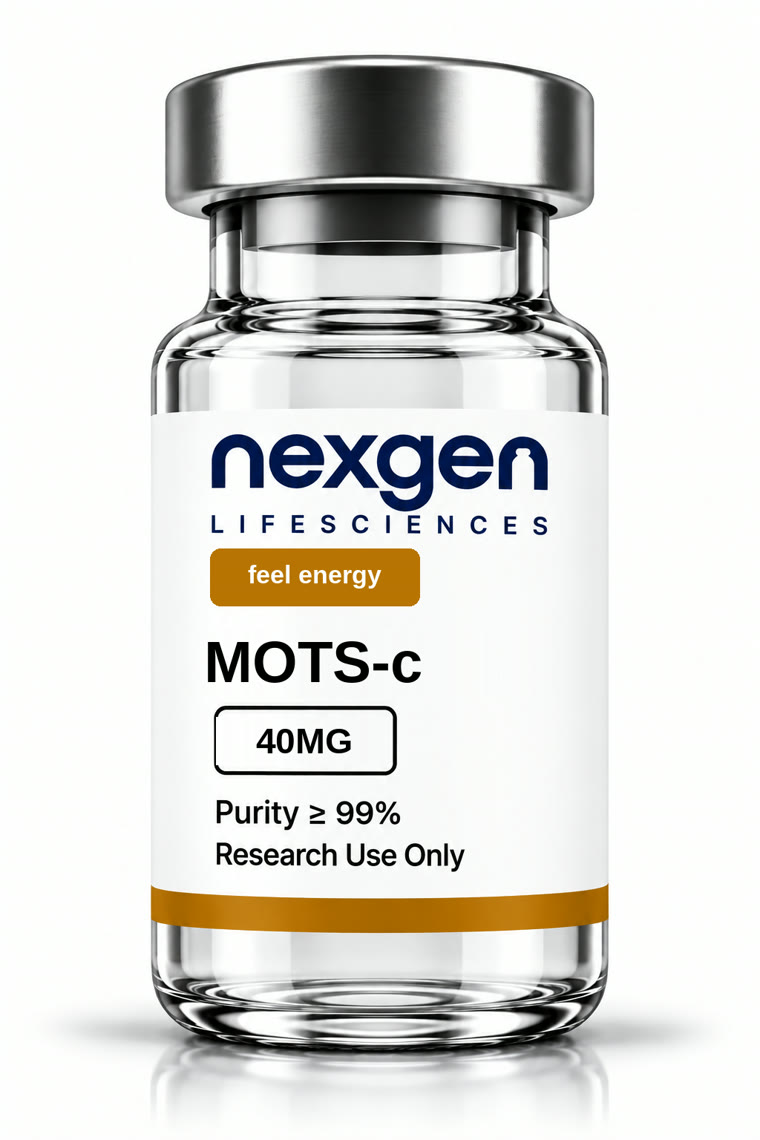
MOTS-c
A peptide written into your mitochondrial DNA, sent out to manage whole-body metabolism.
- Evidence
- ELab & animal what's this?
Grade E for use. Strong animal data; human data are correlations, not interventions. - Also known as
- Mitochondrial ORF of the 12S rRNA type-c
- Class
- Mitochondrial-derived peptide (16 amino acids); AMPK activator, exercise mimetic
What it is
Almost every peptide in this guide is encoded in the cell nucleus. MOTS-c is encoded in the mitochondria’s own small genome, as a signal from the cell’s energy factories to the rest of the body. Exercise raises it, and centenarians tend to have levels like people decades younger. That has earned it the nickname "exercise mimetic".
How it works
What the research shows
In people: the human signal is consistent but correlational. Lower MOTS-c goes with insulin resistance, higher BMI and waist, worse HbA1c and poorer vascular function, and it declines with age2. Intervention trials are essentially absent. In animals: MOTS-c prevented age-related and diet-induced insulin resistance and obesity1, reduced fatty liver, worked with exercise, and improved performance after a single dose3.
Evidence at a glance
| Use | Grade | Best evidence | Main gap | Read |
|---|---|---|---|---|
| Insulin sensitivity | ELab & animal | Prevented insulin resistance and obesity1 | Animal | Strong preclinical |
| Metabolic biomarker | BHuman trials | Low MOTS-c tracks disease2 | Correlation only | Real association |
| Exercise capacity | ELab & animal | Better performance after one dose3 | Animal | Promising |
| Injected human benefit | DCommunity use | Clinic reports | No trial | Extrapolated |
Dosing: what has been reported
| Setting | Figure | Route | Grade |
|---|---|---|---|
| Published human | No intervention dose established | — | — |
| Clinic / community | Start ~2.5 mg; build over ~4 weeks to 5–10 mg, 3–5× weekly; 8–12 weeks on, 4–6 off | Subcutaneous | D |
It’s often timed around training to stack the AMPK effect, or taken in the morning before food on rest days. Its half-life in blood is short, but the downstream effects last longer.
Preparing & storing
Reconstitute with bacteriostatic water, refrigerate and don’t shake.
Reported side effects
- Mild hypoglycaemia, especially with other glucose-lowering agents
- Injection-site redness
- Occasional fatigue, flushing or headache
The benefits are measurable here. Track fasting glucose, HbA1c, insulin/HOMA-IR and body composition.
Who should avoid it
- Pregnancy: it acts on the folate cycle, and folate is critical in pregnancy
- Methotrexate or other folate-pathway drugs
- Diabetes or metformin, berberine or SGLT2 users: monitor glucose
- Tested athletes: an AMPK/AICAR-pathway metabolic modulator, likely prohibited
Regulatory status checked Oct 2026
| Body | Status | Detail |
|---|---|---|
| FDA (US) | Not approved | Under compounding review in 2026. |
| EMA (EU) | Not approved | — |
| CDSCO (India) | Not approved | — |
| WADA | Likely prohibited | Metabolic modulators class; AICAR is explicitly banned. |
A youthful signal worth restoring, if it works
The mechanism is elegant and the animal data are consistent. What’s missing is a human trial that gives MOTS-c and measures the result. Pair it with training and measure your own markers.
References
- Lee C, Zeng J, Drew BG, et al. The mitochondrial-derived peptide MOTS-c promotes metabolic homeostasis and reduces obesity and insulin resistance. Cell Metab. 2015;21(3):443–454.
- Mitochondria-derived peptide MOTS-c: effects and mechanisms related to stress, metabolism and aging. PMC9854231
- Hyatt JK. MOTS-c increases in skeletal muscle following long-term physical activity and improves acute exercise performance after a single dose. Physiol Rep. 2022;10:e15377.