
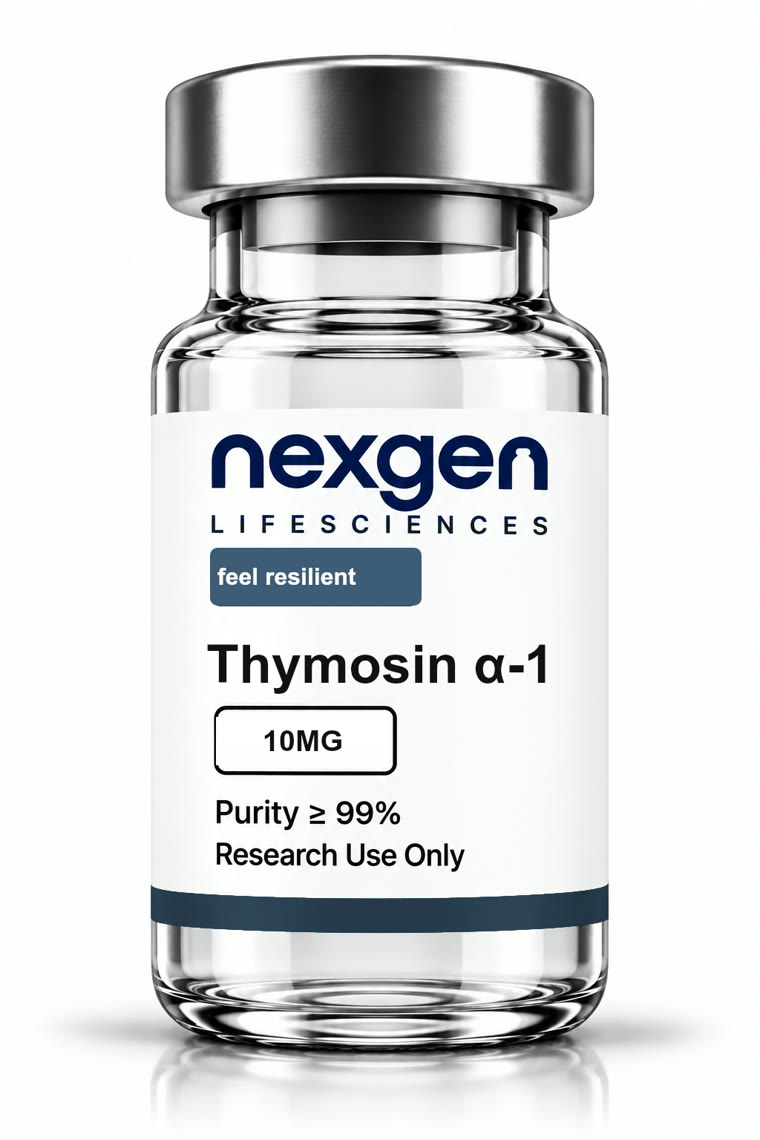
Thymosin Alpha-1
One of the best-evidenced peptides in this guide. It rebalances the immune system rather than simply revving it up.
- Evidence
- AApproved what's this?
Grade A. Approved in 35+ countries; 80+ trials and over 11,000 patients. - Also known as
- Tα1 · Thymalfasin · Zadaxin
- Class
- Synthetic 28-amino-acid thymic peptide; immunomodulator. Approved in 35+ countries.
What it is
Tα1 is unrelated to TB-500 (Thymosin β4), apart from the name, and it isn’t the same as Thymalin, which is a multi-peptide extract. Sold as Zadaxin, it’s approved across Asia, parts of Europe and South America. In a genuine regulatory paradox, it has never been FDA-approved despite orphan designation in 1991.
How it works
What the research shows
Hepatitis B: meaningfully higher sustained viral response than placebo, which established it across Asia2. Cancer: more than 40 trials as an adjunct to chemotherapy or immunotherapy, with preserved immune counts, better quality of life and, in some, longer survival. Vaccines: antibody responses in the elderly improved by about 40%. Sepsis: the TESTS trial (1,106 patients, BMJ 2025) is the largest Tα1 RCT. It did not significantly reduce 28-day mortality overall, which tempers earlier hopes from smaller studies3. The safety record across more than 11,000 patients is consistently clean1,2.
Evidence at a glance
| Use | Grade | Best evidence | Main gap | Read |
|---|---|---|---|---|
| Chronic hepatitis B | AApproved | Higher sustained viral response2 | Regional data | Approved |
| Cancer adjunct | BHuman trials | Preserved immunity; some survival gains | Variable design | Supportive |
| Sepsis | BHuman trials | TESTS: no overall mortality reduction3 | Subgroups debated | Not proven |
| Immune ageing | CClinical off-label | Restores competence; vaccine response | Extrapolated to healthy | Reasonable |
Dosing: what has been reported
| Setting | Figure | Route | Grade |
|---|---|---|---|
| Approved (hepatitis) | 1.6 mg twice weekly for 6–12 months | Subcutaneous | A |
| Cancer / sepsis research | 1.6–3.2 mg twice weekly, or per protocol | Subcutaneous | B |
| Community loading | 1–1.5 mg daily for 10–30 days | Subcutaneous | D |
| Community maintenance | 1.6 mg twice weekly | Subcutaneous | D |
The 1.6 mg dose is unusually consistent across settings, a sign of an established pharmaceutical standard.
Preparing & storing
Reconstitute with bacteriostatic water (or as the label directs), keep cold and away from light, and don’t shake.
Reported side effects
- Mild injection-site redness or discomfort, often the only effect
- Occasional minor, passing reactions
- No significant treatment-related adverse events at therapeutic doses in large trials
It’s used alongside interferon in hepatitis and as a vaccine adjuvant. Immunosuppressants oppose its effect. Track a CBC with lymphocytes, and T-cell subsets if available.
Who should avoid it
- Organ transplant on immunosuppression: specialist guidance only
- Active autoimmune disease: specialist input
- Pregnancy and breastfeeding: medical guidance only
Regulatory status checked Oct 2026
| Body | Status | Detail |
|---|---|---|
| FDA (US) | Not approved | Investigational; restricted compounding since 2023. |
| EMA (EU) | Not centrally | National approvals, e.g. Italy. |
| Other markets | Approved | Zadaxin in 35+ countries (China, SE Asia, S. America). |
| WADA | Not prohibited | Permitted, unlike TB-500. |
An immune peptide with real clinical weight
Tα1 is a defined, approved, very safe molecule with a large trial record. It’s best supported for restoring immune competence in people who have lost it. Some disease-specific claims, including sepsis, are less certain than its marketing suggests.
References
- Goldstein AL, Low TL, McAdoo M, et al. Thymosin α1: isolation and sequence analysis of an immunologically active thymic polypeptide. PNAS. 1977;74(2):725–729.
- Garaci E, Pica F, Rasi G, Favalli C. Thymosin α1: from bench to bedside. Ann N Y Acad Sci. 2007;1112:225–234.
- Wu J, et al. Thymosin α1 in patients with sepsis (TESTS): a multicentre randomized controlled trial. BMJ. 2025.