
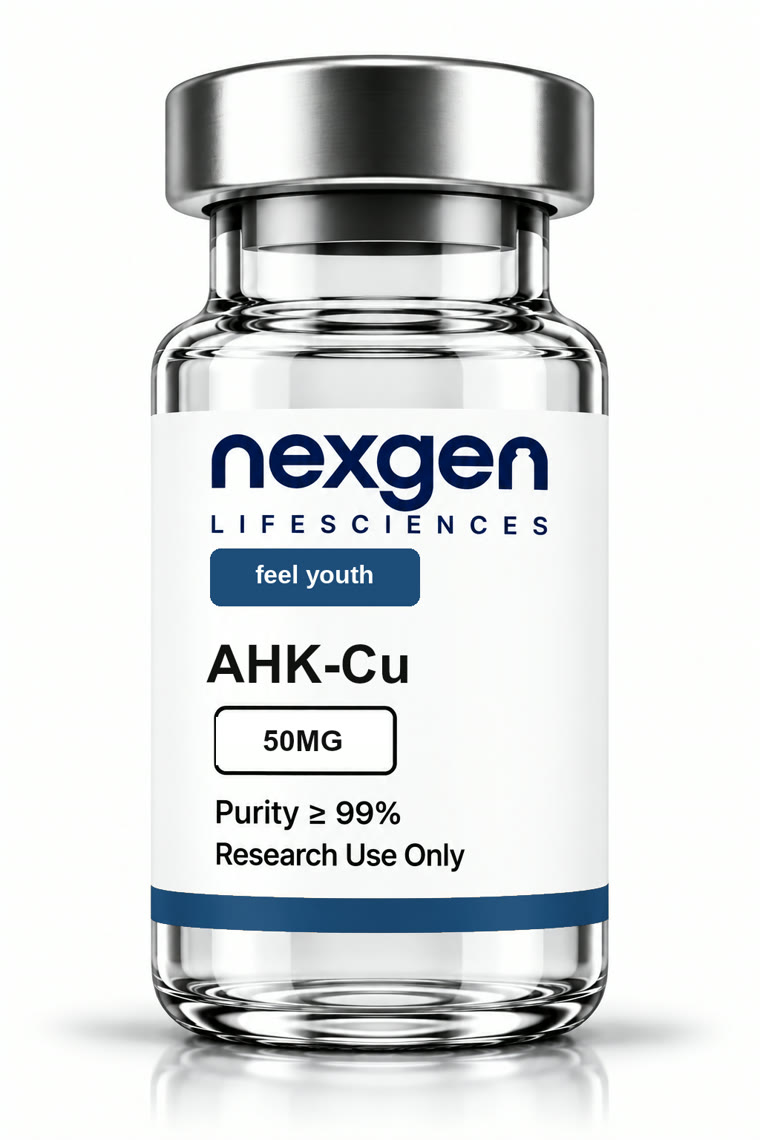
AHK-Cu
GHK-Cu’s hair-focused cousin. One amino acid is swapped, and the target moves to the hair follicle.
- Evidence
- ELab & animal what's this?
Grade E. It rests on essentially one laboratory study. Systemic injection is unsupported. - Also known as
- Copper Tripeptide-3 · Ala-His-Lys copper
- Class
- Synthetic copper-binding tripeptide (~417 Da); cosmetic ingredient
What it is
AHK-Cu is a small synthetic copper peptide. The copper does the work, and the three amino acids carry it to the right place. It’s a topical and local agent found in hair serums and some scalp-injection protocols. It isn’t meant to be a systemic injectable, and nothing supports using it that way.
How it works
What the research shows
In the lab: Pyo and colleagues (2007) treated cultured human hair follicles and papilla cells with picomolar-to-nanomolar AHK-Cu. Follicles lengthened, papilla cells proliferated, VEGF rose and TGF-β1 fell. A reduction in cell death didn’t reach significance1. In people and animals: there’s no standalone trial. The impressive copper-peptide hair numbers mostly belong to GHK-Cu, to combination products, or to studies that added microneedling.
Evidence at a glance
| Use | Grade | Best evidence | Main gap | Read |
|---|---|---|---|---|
| Hair growth, topical | DCommunity use | Follicle elongation in culture1 | One lab study | Plausible |
| Follicle blood supply | ELab & animal | VEGF up, TGF-β1 down1 | Cell level | Theory support |
| Systemic injection | ELab & animal | No data | — | Not supported |
Dosing: what has been reported
| Setting | Figure | Route | Grade |
|---|---|---|---|
| Published human | None (culture concentrations only) | — | — |
| Cosmetic serum | 100–500 ppm (0.01–0.1%), kept under ~0.2%, daily | Scalp | D |
| Scalp mesotherapy | ~0.5–1 mg/mL, 1–2 mL per session, weekly to monthly | Intradermal | D |
| Systemic subcutaneous | Not supported | — | — |
Apply to a clean scalp, since oil and product build-up block what little gets through. Microneedling is often used to open a path. Judge results only after 3–6 months.
Preparing & storing
Serums come ready-made. Powder for mesotherapy reconstitutes like other copper peptides: bacteriostatic water first, dilute acetic acid if it stays cloudy. Refrigerate once mixed. Don’t combine with high-dose vitamin C in the same preparation.
Reported side effects
- Scalp irritation or redness (most common)
- Itching or dryness at the application site
- A faint greenish tint on very light hair
- Needle-site redness or bruising with mesotherapy
- Uncommon contact allergy to copper or preservatives
Track progress with standardised photos every 4–8 weeks. Hair change is too slow to judge by eye from day to day.
Who should avoid it
- Broken, inflamed or infected scalp
- Copper allergy; Wilson’s disease or other copper disorders
- Don’t inject copper peptides systemically or stack them
- Pregnancy: low concern topically, but ask a doctor
Regulatory status checked Oct 2026
| Body | Status | Detail |
|---|---|---|
| FDA (US) | Cosmetic ingredient | Not a drug; not part of the peptide reclassification. |
| EMA (EU) | Cosmetic ingredient | — |
| CDSCO (India) | Not approved as drug | — |
| WADA | Not named | Topical use is no doping concern. |
Low risk and low proof
AHK-Cu is a sensible cosmetic hair ingredient with a tidy lab rationale. Expect cosmetic-level results, give it months, and don’t inject it.
References
- Pyo HK, Yoo HG, Won CH, et al. The effect of tripeptide-copper complex on human hair growth in vitro. Arch Pharm Res. 2007;30(7):834–839. PMID 17703734