
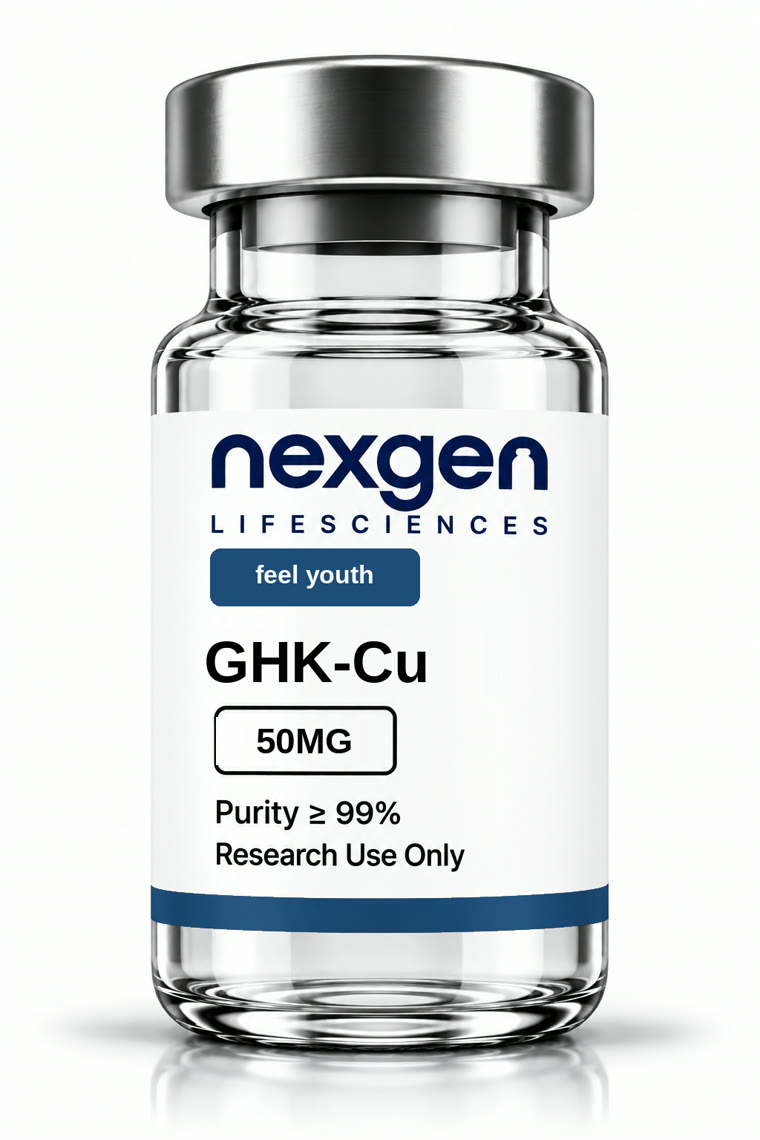
GHK-Cu
The original copper peptide. Your blood carries less of it every decade, and it coordinates repair across thousands of genes.
- Evidence
- BHuman trials what's this?
Grade B for topical skin use. Injected systemic use is Grade D, extrapolated. - Also known as
- Copper Tripeptide-1 · glycyl-L-histidyl-L-lysine copper
- Class
- Naturally occurring copper-binding tripeptide; tissue-repair signal
What it is
In 1973 Loren Pickart found that something in young people’s blood made old liver tissue behave young again. It turned out to be GHK, a three-amino-acid peptide that binds copper. It circulates in plasma, saliva and urine, rises naturally at sites of injury, and declines by about 60% between 20 and 60. That decline is why it attracts so much longevity interest. It’s a staple cosmetic ingredient and, in the peptide community, an injectable. The solution is naturally blue.
How it works
What the research shows
In people (topical): placebo-controlled studies on ageing, sun-damaged skin reported better firmness, elasticity, clarity and fewer fine lines. In one biopsy study GHK-Cu increased collagen in most treated women, beating vitamin C and retinoic acid creams1. In animals: across many wound models it sped closure by roughly 20–30%, strengthened healed tissue, improved graft take and grew new vessels1. In the lab: it stimulates collagen at tiny concentrations and revives radiation-damaged fibroblasts1,3. Gene-expression work suggests it influences thousands of human genes, many tied to repair2.
Evidence at a glance
| Use | Grade | Best evidence | Main gap | Read |
|---|---|---|---|---|
| Topical skin rejuvenation | BHuman trials | Firmness, elasticity, collagen up1 | Topical only | Genuinely evidenced |
| Wound and tissue repair | ELab & animal | 20–30% faster closure in animals1 | Animal | Strong preclinical |
| Collagen and matrix | ELab & animal | Collagen, elastin, GAGs up3 | Cell level | Well mapped |
| Injected systemic benefit | DCommunity use | Assumed from topical and mechanism | No systemic trial | Extrapolated |
Dosing: what has been reported
| Setting | Figure | Route | Grade |
|---|---|---|---|
| Published (topical) | Serums around 1–3 ppm and up, daily1 | Skin | B |
| Community, systemic | ~1–2 mg/day in cycles | Subcutaneous | D |
| Clinic mesotherapy | Low mg per session, weekly to monthly | Intradermal | D |
Preparing & storing
Can be stubborn to dissolve. Start with bacteriostatic water and switch to dilute acetic acid if it stays cloudy. A blue or turquoise tint is normal. Refrigerate once mixed and keep it away from strong reducing agents. Don’t apply high-dose vitamin C at the same time, because it destabilises the copper complex.
Reported side effects
- Topical: mild irritation or redness in sensitive skin
- A harmless blue-green tint on skin or in solution
- Injection-site stinging, more with acetic-acid preparations
- Occasional headache or flushing with systemic use
- Copper load with long-term injection or stacked copper peptides
For long-term systemic use, check serum copper periodically. Standardised photos are the best way to judge skin or hair change.
Who should avoid it
- Wilson’s disease or other copper-handling disorders
- Copper allergy
- Don’t stack copper peptides by injection (GHK-Cu + AHK-Cu)
- Pregnancy: topical is low concern, injection unstudied
Regulatory status checked Oct 2026
| Body | Status | Detail |
|---|---|---|
| FDA (US) | Cosmetic ingredient | Injectable use not approved. |
| EMA (EU) | Cosmetic ingredient | Not a medicine. |
| CDSCO (India) | Not approved as drug | — |
| WADA | Not named | Topical use is no concern; S0 could apply to systemic injection. |
The best-evidenced peptide for skin
GHK-Cu has controlled human data on skin and decades of repair biology behind it. On skin, the evidence is solid. Injected, it is an educated extrapolation, so keep an eye on total copper intake.
References
- Pickart L, Vasquez-Soltero JM, Margolina A. GHK peptide as a natural modulator of multiple cellular pathways in skin regeneration. Biomed Res Int. 2015;2015:648108.
- Pickart L, Margolina A. Regenerative and protective actions of the GHK-Cu peptide in the light of the new gene data. Int J Mol Sci. 2018;19(7):1987.
- Maquart FX, Pickart L, Laurent M, et al. Stimulation of collagen synthesis in fibroblast cultures by GHK-Cu. FEBS Lett. 1988;238(2):343–346.